
800.704.0986 
- Improving lives since 2002
- Fast, Friendly Service
- Free Nutritional Counseling
The key to health is eliminating toxicities and deficiencies! - Dr. William R. Kellas


800.704.0986
The key to health is eliminating toxicities and deficiencies! - Dr. William R. Kellas
A more refined expression of an unusual category. Healthy-Living selected Synergy O2 as our premium H2 + O2 formula because a supplement should be judged by the whole experience: the breadth of its matrix, the thought behind the formulation, and how comfortably it fits into daily life.
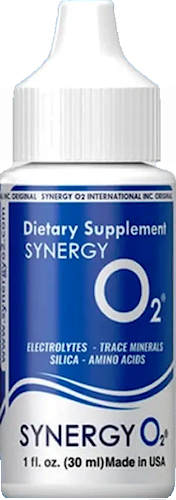
Oxygen and hydrogen have different biological relevance. Oxygen is the final electron acceptor in aerobic energy production. Molecular hydrogen, in broader research, is studied for redox modulation and cellular stress signaling. Synergy O2 has not published a product-specific gas assay, so this page distinguishes established chemistry and general H2 research from claims about what one serving produces.
The current technical sheet names 24 mineral or elemental entries and 18 amino compounds, while the bottle lists deionized water, hydrogen sulfate, sea water extract, an ionic trace-mineral blend, a trace amino-acid blend, and silica. That breadth is why we position Synergy O2 as premium cellular nutrition—not simply “liquid oxygen.”
Experience note: taste, stomach comfort, and perceived vitality are personal reports, not typical outcomes established by a representative survey or a head-to-head clinical trial.
O2 is essential to aerobic energy production. General molecular-hydrogen research examines H2 for redox modulation, cellular defense signaling, and mitochondrial resilience. If Synergy O2 produces H2 through the company-described dissociation process, hydrogen deserves a central place in the story.
The company describes Synergy O2 as a water-dissociation and cellular-nutrition formula. The chemistry of complete splitting gives hydrogen and oxygen distinct places in the story, while the mineral, electrolyte, silica, and amino-compound matrix gives the formula its broader character.
Evidence distinction: the formula counts come from current company materials; the H2/O2 equation is established chemistry; the biological discussion comes from general molecular-hydrogen research; and the taste, comfort, and vitality observations are anecdotal customer reports.
Premium concentrated hydrogen-and-oxygen concept with minerals, electrolytes, silica, and amino compounds
Synergy O2 is a premium-priced formula. We carry it for people who value the published mineral, silica, and amino matrix—and who care whether a product is pleasant enough to use consistently. A less expensive bottle that stays in the cupboard is not the better value.
Questions before ordering? Call 800.704.0986 for friendly help and practical guidance. The bottle size and directions printed on the inventory you receive are controlling.
We are ready to help you order the correct product.
Call 800.704.0986Monday–Friday, 9:00 a.m.–2:00 p.m. Mountain Time
Synergy O2 literature says the formula initiates dissociation of some water molecules into hydrogen and oxygen. Those atoms would not remain isolated for long. If the described process proceeds to stable molecular products, hydrogen atoms pair as H2 and oxygen atoms pair as O2. That completed chemistry immediately changes the emphasis: for every one O2 molecule, there are two H2 molecules.
O2 helps create ATP. H2 helps preserve the redox environment that allows the ATP-making machinery to keep working efficiently.
Redox is the controlled flow of electrons through the cell. It powers energy production, communication, repair, immune defense, and adaptation. But electron transfer is never perfectly clean. Highly reactive species can escape, attack membranes and proteins, and start self-propagating oxidative chain reactions. The value of molecular hydrogen is not that it attempts to eliminate every reactive molecule. Its potential value is more intelligent: limit the most destructive spillover while preserving the useful signals cells need.
Molecular hydrogen and oxygen provide the central water-dissociation narrative; the formula beneath that narrative is unusually broad. The company’s current technical sheet identifies a 1 fl. oz. / 30 mL bottle and publishes concentrations in mg/L for 24 named mineral or elemental entries and 18 amino compounds. These numbers describe the concentrate, not the amount delivered by eight drops.
The serving size is 8 drops (0.34 ml). There are 90 servings per container, and 326 mg of the proprietary blend per serving.
The bottle lists the blend as deionized water, hydrogen sulfate, sea water extract, ionic trace mineral blend, trace amino acid blend, and silica. Hidden within those words are its proprietary ingredients and technology.
The detailed mineral and amino-compound tables below come from the company technical sheet and expand on the bottle's broader blend categories. They should not be mistaken for separately declared amounts per 8-drop serving.
| Entry | mg/L |
|---|---|
| Boron | 1.678 |
| Chromium | 0.116 |
| Cobalt | 1.183 |
| Copper | 0.12 |
| Fluoride | 0.07 |
| Germanium | 0.36 |
| Iodine | <0.005 |
| Iron | 336 |
| Manganese | 14.7 |
| Molybdenum | 0.001 |
| Rubidium | 0.0444 |
| Selenium | 0.0077 |
| Silicon | 97 |
| Vanadium | 0.0505 |
| Zinc | 405.5 |
| Entry | mg/L |
|---|---|
| Calcium | 154 |
| Carbon | 66 |
| Chloride | 154 |
| Magnesium | 389 |
| Nitrogen | 605 |
| Phosphorus | 0.005 |
| Potassium | 8.87 |
| Sodium | 84.2 |
| Sulfate | 12,317 |
| Entry | mg/L |
|---|---|
| Alanine | 1,200 |
| Glutamic acid | 2,040 |
| Arginine | 1,100 |
| Aspartic acid | 124.0 |
| Cystine | 91.9 |
| Phenylalanine | 400 |
| Glycine | 3,200 |
| Histidine | 160 |
| Isoleucine | 230 |
| L-carnitine | 250 |
| Lysine | 880 |
| Methionine | 190 |
| Proline | 2,130 |
| Serine | 540 |
| Threonine | 90 |
| Tryptophan | 120 |
| Tyrosine | 200 |
| Valine | 600 |
Silica is not hidden in secondary marketing language: it appears on the current bottle, and the technical sheet lists silicon at 97 mg/L in the concentrate. This makes it essentially two products in one: a premium water disassociator and an excellent supply of premium silica.
An older translated handout uses the term deuterium sulfate. The current bottle says hydrogen sulfate, and the current technical sheet lists sulfate at 12,317 mg/ . We have not received a current specification establishing “pharmaceutical-grade deuterium sulfate,” although the company verbally says this is true.
Similar category language does not mean identical formulation or experience. Products can differ in processing, acidity, mineral balance, silica content, amino profile, concentration, flavor, after-feel, and release kinetics. Synergy O2’s premium case rests on the total system—not on one unmeasured mechanism.
What is known versus inferred: the formula details come from company materials; the taste, comfort, and vitality observations are anecdotal; and the precise reason one person prefers one formula remains unmeasured.
CellFood deserves a fair description. NuScience identifies it as the original formula developed by Everett Storey, used for more than 50 years and sold in more than 90 countries. It has a long history and a loyal following. Synergy O2 does not need that history diminished to make its own case.
Synergy O2 is a separate product from a separate company. Its official history credits founder Raúl De La O, and its current materials describe a highly mineralized formula with electrolytes, plant-derived silica, amino compounds, and a water-dissociation concept. No public document establishes shared ownership, an identical formula, or a head-to-head clinical result.
The two product documents do not give identical directions, so source hierarchy matters.
The sheet depicts a 1 fl. oz. / 30 mL bottle.
It also says to shake, use glass or plastic, avoid hot drinks and dairy, and take the drops about 10 minutes before meals.
Packaging and directions can change; the physical label is more authoritative than an older online handout.
Not medical oxygen: Synergy O2 should not replace prescribed oxygen, evaluation of low oxygen saturation, or care for breathing difficulty, chest pain, or another urgent symptom.
This page now separates three things clearly: what Synergy O2 says about water dissociation, what complete chemistry says about H2 and O2, and what the broader molecular-hydrogen literature says about redox biology. The Scribd document adds useful formula and historical detail, but it also mixes marketing language, dosing protocols, disease claims, rectal-use instructions, and “healing crisis” advice. It is therefore used as secondary product literature, while current manufacturer materials and primary H2 research carry more weight.
Because the product name draws attention to oxygen while the complete chemistry of water splitting gives us 2H2 + O2. Oxygen helps mitochondria complete aerobic energy production. Molecular hydrogen may help regulate the redox environment, limit destructive oxidative chain reactions, engage internal defense pathways, and support mitochondrial resilience. The exact H2 output of Synergy O2 still needs to be measured, but hydrogen is too important to remain a footnote.
H2 does not need to supply calories or stimulate the nervous system to matter. Its proposed value is reducing oxidative interference around the machinery that already makes energy. In simple terms, oxygen helps complete the circuit; hydrogen may help the circuit run with less redox friction.
That is how the translated handout describes the formula, and the current company website says more than 73 colloidal elements. The current technical sheet names and quantifies 24 mineral or elemental entries. A complete public list of every claimed element was not located, so the accurate wording is “the company claims 70-plus elements; 24 are named and quantified in the current sheet.”
The current technical sheet lists 18 amino-related entries. Seventeen are amino acids and one is L-carnitine, an amino-acid derivative. The sheet labels the group “essential amino acids,” although several listed amino acids are not nutritionally essential. This page therefore uses the more precise term 18 amino compounds.
The public documents do not establish that. An older translated handout uses the term deuterium sulfate; the current bottle says hydrogen sulfate, and the technical sheet lists sulfate at 12,317 mg/L without identifying the isotope or raw-material grade. Healthy-Living will not call it pharmaceutical grade unless the manufacturer supplies a current written specification.
The current company technical sheet says 8 drops in 16 ounces of water, three times daily. The older translated handout contains several different graduated schedules. The printed directions on the bottle Healthy-Living ships should control.
No. The products occupy a related category, but they come from different companies and have different current disclosures. NuScience identifies CellFood as the original Everett Storey formula. Synergy O2 credits founder Raúl De La O and publishes its own mineral, amino-compound, silica, and electrolyte profile. No identical formula or shared ownership has been verified.
That has not been established. Some comparison users report a more noticeable experience with Synergy O2, but no public head-to-head assay proves greater water splitting or greater production of H2 or O2. The preference is worth reporting as experience; the mechanism remains unmeasured.
Because the premium case is broader than a single ingredient. The current materials disclose a highly mineralized matrix, silica, electrolytes, and 18 amino compounds; comparison feedback shared with us also favors its taste, after-feel, stomach comfort, and everyday usability. “Premium” is Healthy-Living’s judgment about the total formula and experience, not a claim of FDA approval or clinical superiority.
It is positioned as a premium choice rather than the lowest-cost entry in the category. We believe value includes formula breadth, the experience of taking it, and whether a person is likely to remain consistent. Price alone does not prove quality, and individual preference still matters.
The handout lists disease-treatment claims, rectal use, universal use in pregnancy and infancy, and advice to continue through worsening symptoms as a “healing crisis.” Those statements require substantially stronger evidence and safety support than the document provides, so they were not converted into Healthy-Living recommendations.
Synergy O2 is better described as a water-dissociation or hydrogen-releasing concept than as conventional pre-measured hydrogen water. Standard hydrogen water is normally characterized by a published dissolved-H2 concentration. Synergy O2’s proposed chemistry makes H2 central, but the manufacturer has not yet published the concentration produced by a labeled dose.
It is marketed as a dietary supplement rather than a stimulant. Its formula emphasis is minerals, electrolytes, silica, amino compounds, and oxygen activation—not caffeine or sugar. It is also not medical oxygen and should not replace prescribed oxygen or evaluation of a breathing or oxygen-saturation problem.
Synergy O2 does not need to tear down the product that helped establish this category. CellFood has a long history and devoted users. Our preference is simpler: we believe Synergy O2 presents the more refined premium experience for the customer who cares about formula detail, taste, stomach comfort, and the likelihood of staying consistent.
The formula has genuine depth. Current company materials identify a highly mineralized matrix with 24 named mineral or elemental entries, 18 amino compounds, electrolytes, and silica. The company also describes a water-dissociation concept in which hydrogen and oxygen both belong in the story, although product-specific H2 and O2 output has not been published.
The customer experience is the practical reason we chose it. The reports shared with Healthy-Living lean toward a cleaner taste and after-feel, gentler stomach experience, and more noticeable everyday vitality. Those observations are anecdotal and cannot promise what every person will feel, but they matter because a premium supplement only creates value when people are comfortable enough to keep using it.
Our honest description: CellFood is the respected original; Synergy O2 is our premium choice. It costs more, but for the person who prefers the experience and remains consistent, it may prove to be the better value.
These statements have not been evaluated by the Food and Drug Administration. Synergy O2 is not intended to diagnose, treat, cure, or prevent any disease. Customer experiences vary, and no head-to-head clinical trial establishes superiority over another product.
Copyright 2002 - 2026. All rights reserved.
These statements have not been evaluated by the Food and Drug Administration. No product mentioned herein is intended to diagnose, treat, cure or prevent any disease. If you are pregnant, nursing, taking medication, or have a medical condition, consult your physician before making any lifestyle change, including trying a new product or food.
The information on this website is intended as a sharing of knowledge and information from the research and experience of the Healthy-Living.Org staff and contributors. It is not intended to replace a one-on-one relationship with a qualified health care professional and it is not intended as medical advice. You should not use the information on this site for diagnosis or treatment of any health problem or for modification of any medication regimen. You should consult with a healthcare professional before starting any diet, exercise or supplementation program, before starting or discontinuing any medication, or if you suspect you have a health problem. You should keep in mind that cited references to ongoing nutritional scientific study are most likely not accepted by the FDA as conclusive. These references and mentions of benefits experienced by others are disavowed as product claims and are only included for educational value and as starting points for your own research. No food or supplement can be considered safe for all individuals. What may benefit 999,999 of a million people may harm you. Therefore, no one can take responsibility for your health except you in concert with your trusted health professional.

