


What does a golden-yellow barberry root have to do with your blood sugar?
Cut into a barberry root and you’ll find a yellow so rich it once colored silk. One of the compounds behind that color is berberine. What earns it a place on our shelves at Healthy-Living? Two numbers you may have circled on your last lab report.
In a review of 12 clinical trials in adults with metabolic risk factors, fasting blood sugar averaged about 9 mg/dL lower with regular berberine than with placebo. Triglycerides averaged about 32 mg/dL lower. The doses and results varied across studies.
Here’s one place regular berberine outperformed dihydroberberine. In a head-to-head experiment with cultured human liver cells, regular berberine produced a stronger increase in LDL receptor gene expression. Those receptors help your liver remove LDL particles from your bloodstream. Whether one form lowers LDL cholesterol more in people remains an open question.
Why choose classic berberine HCl? It’s the form with the longer track record in human studies of blood sugar and cholesterol. You can read the research, check the label, and recognize the same ingredient. Each capsule supplies 500 mg. At $19.95 for 60 servings, that’s about 33 cents per serving.
The classic berberine capsule
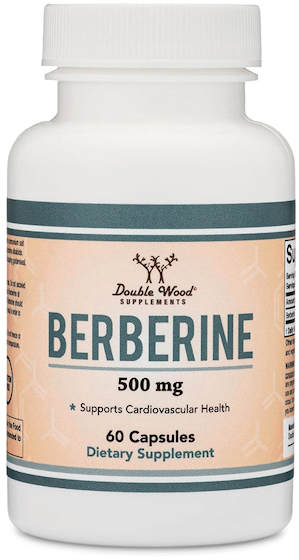
Double Wood uses berberine hydrochloride (HCl), a form widely used in human studies of blood sugar and cholesterol. Each capsule gives you 500 mg of berberine HCl from Indian barberry (Berberis aristata). There are 60 capsules in a bottle.
Why choose berberine over dihydroberberine?
If you want the form with the longer track record in people, choose regular berberine. Researchers have followed people taking it for weeks or months and measured changes in fasting blood sugar, triglycerides and LDL cholesterol. That gives you more to go on when one of those numbers is the reason you’re interested.
If LDL cholesterol or triglycerides are the numbers you watch on your lab report, classic berberine HCl has the longer track record in human studies. Placebo-controlled trials found modest reductions in both. In one eight-week trial, people with diarrhea-predominant IBS also reported fewer episodes of diarrhea, urgency, and abdominal pain. Dihydroberberine’s clearest advantage is greater absorption at a smaller dose. Whether either form delivers better cholesterol or digestive results in people, or pairs better with other herbs, remains an open question.
Does higher absorption change the result?
In a crossover study, five men tried both forms. Smaller doses of dihydroberberine produced higher blood levels of berberine. Yet their blood sugar and insulin responses after a test meal were similar across the study conditions. This short experiment leaves open which form gives better results over time.
What if regular berberine already suits you?
If you tolerate regular berberine and it fits your routine, higher absorption alone is little reason to switch. If you prefer the smaller milligram dose of dihydroberberine, that’s a practical difference worth weighing. The milligram numbers on the two bottles aren’t interchangeable.
Fasting glucose is your blood sugar after going without food overnight. Trials in people with metabolic risk factors have found modest average improvements with berberine. People whose readings are already in a healthy range may see little change.
A lipid panel measures fats in the blood. Several trials of standard berberine have reported lower average LDL cholesterol and triglycerides. Study results vary with the population, dose and duration.
HCl stands for hydrochloride. The 500 mg on this label refers to the amount of berberine HCl in one capsule. At $19.95 for 60 capsules, that comes to about 33 cents per capsule.
Where does berberine fit in your plan?
If you’re dieting
If your goal is to lose weight and keep an eye on your blood sugar or cholesterol, those lab numbers are the better reason to consider berberine. Across a review of 23 studies, people taking berberine lost about two pounds more on average than comparison groups. Results varied, and a six-month trial found no meaningful advantage for deep abdominal fat. Build your meals around foods you enjoy and can keep eating, including protein and fiber.
If you use a “GLP-1 support” supplement
Turn the bottle around. Some blends contain fiber or probiotics, while others already include berberine. If yours is a fiber product and you also want a clearly measured amount of berberine for glucose or lipid support, a single-ingredient capsule lets you see exactly how much you’re getting. If berberine or dihydroberberine is already listed, skip the extra bottle until you’ve checked the total. Studies have yet to show that adding the capsule to a GLP-1 support blend helps people lose more weight.
If you take semaglutide or tirzepatide
These are prescription medicines. Adding berberine has no established benefit for extra weight loss or for breaking a plateau. If you’re interested in it for a separate reason, such as your cholesterol, bring the label to your prescriber or pharmacist first. Both products can cause digestive symptoms. If you also use insulin or a medicine such as glipizide, ask about the risk of low blood sugar before adding berberine.
If you’re taking “reta” (retatrutide)
As of November 2026, retatrutide remains investigational in the United States. There’s no established benefit or safety guidance for combining it with berberine. If you’re in a retatrutide trial, ask the study team before adding a supplement. If you obtained a product sold online as “research use only,” avoid using it and tell your healthcare professional what you’ve taken.
Order Double Wood Berberine
$19.95 per bottle
Item #1244 · 60 capsules
Or call 800-704-0986 to order.
Berberine Supplement Facts
Supplement Facts
Serving size 1 capsule
Servings per container 60
| Ingredient | Amount per serving | % DV |
|---|---|---|
| Berberine HCl | 500 mg | † |
† Daily Value (DV) has not been established.
How to take it
Take the capsule with a meal. Follow the daily serving directions printed on your bottle.
Before use. Avoid berberine during pregnancy or breastfeeding, and never give it to an infant. If you take medication, have a pharmacist check for interactions. Cyclosporine and medicines that lower blood sugar deserve particular attention.
Videos about Berry Extreme
We disclaim any claims (if there are any) made in these videos. They are for information, education, enlightenment and entertainment only.

