


Most people think aging is inevitable. Much of what we call aging begins when cells lose the energy and cellular resources they need to repair, renew, and function like younger cells.
At the center of that process is NAD+. Your cells depend on it for mitochondrial energy production, cellular repair, healthy gene activity, and many of the processes associated with youthful cellular function.
The problem is not merely that NAD+ declines with age. The machinery that makes and recycles it can slow while enzymes that consume it become more active. Simply adding another precursor may therefore address only one part of the problem.
Nuchido asked a bigger question: What if, instead of simply adding more raw material, we helped restore the body’s own ability to make, recycle, and preserve NAD+?
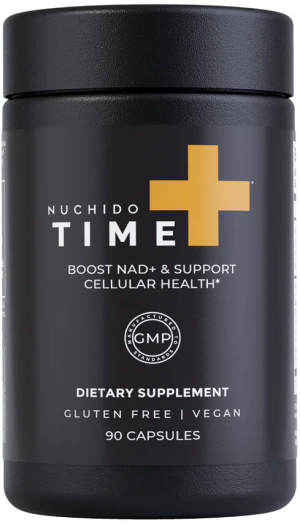
That is the idea behind patented Nuchido TIME+. It uses a clinically studied, whole-system strategy designed around the biology that controls NAD+ itself.
- Supports mitochondrial and cellular energy without relying on a stimulant jolt
- Supports the NAMPT-driven salvage pathway that recycles nicotinamide into fresh NAD+
- Helps address excessive NAD+ drain rather than merely pouring in more precursor
- Supports repair and resilience pathways associated with sirtuins, DNA maintenance, and healthy aging
Order — Nuchido TIME+
90 capsules · 30-day supply · 3 capsules per daily serving
Comparative Retail Price: $89.00
Our Price: $65.00 (≈ $2.17 per day)
Three capsules, all at once or divided
Designed for use with or without food
Questions before ordering? Call 800.704.0986 for friendly help and nutritional guidance.
What NAD++ actually does—and why losing it changes everything
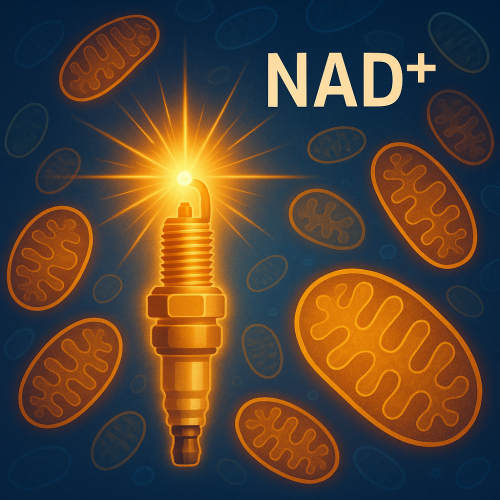
Think of NAD++ as the spark plug of the body’s energy engine. Inside the mitochondria, it accepts and donates electrons as food and oxygen are transformed into ATP—the usable energy that powers every heartbeat, thought, movement, and repair process.
NAD++ is also a signaling molecule. Enzymes such as sirtuins and PARPs depend upon it to coordinate stress responses, DNA maintenance, circadian timing, and cellular repair. When the available pool becomes inadequate, the body may still have food and oxygen, but the cellular machinery can have less capacity to convert those resources into useful work.
This creates a two-sided challenge. Cells need NAD++ to generate the energy required for immediate activity, while repair enzymes consume NAD++ as they respond to ordinary wear, oxidative stress, and damage. When demand rises while the available supply is declining, cells may have less energy for performance and fewer resources for maintenance. The effects can be especially noticeable in tissues with high energy requirements, including the brain, heart, muscles, and immune system. In other words, energy production and cellular upkeep compete for the same resource.
When NAD++ falls, aging can begin to look less like passing time—and more like a progressive cellular power failure.
That is why NAD++ support can feel more foundational than a typical “energy” product. It does not simply stimulate the nervous system. It supports the biology through which cells make energy and maintain themselves.
Why Nuchido TIME+ makes more sense than a basic precursor-only NAD supplement
The formula tells a more complete biological story. NR and NMN primarily add raw material. Nuchido TIME+ is designed around the wider NAD+ network: production, recycling, retention, and the pathways that use NAD+.
1. Make more
Support the body’s NAD+-producing machinery, including NAMPT—the rate-limiting enzyme in the salvage pathway that recycles nicotinamide into fresh NAD+.
2. Recycle more
Keep useful material moving through the salvage pathway instead of allowing the cellular recycling line to become an overlooked bottleneck.
3. Preserve more
Address unnecessary NAD+ drain, including age-related consumption associated with CD38 and chronic cellular stress.
4. Put it to work
Support the downstream pathways that use NAD+ for mitochondrial output, repair signaling, stress adaptation, and cellular resilience.
Produce more. Recycle more. Preserve more. That is why TIME+ is fundamentally different from simply taking another NAD+ precursor.
What low NAD+ capacity can look like
Usually not one dramatic event—more often a gradual loss of cellular headroom.
- Energy feels less steady: fatigue, sluggishness, or a pronounced afternoon decline
- Recovery feels slower: physical and mental stress take more out of you
- Thinking feels less durable: less focus, memory stamina, or willingness to engage
- Metabolic flexibility feels weaker: the body has a harder time shifting efficiently between demands
- Aging feels more noticeable: less resilience, less repair, and less capacity than you once took for granted
What people are usually looking for instead
Not artificial stimulation. More useful cellular capacity.
- Steadier daytime energy without a caffeine-style rush and crash
- Better mental stamina for work, conversation, and demanding days
- More efficient recovery from exercise, travel, stress, and lost sleep
- Stronger repair signaling as part of a broad healthy-aging strategy
- A simple daily anchor that fits with sleep, movement, hydration, and nutrient-dense food
Fix the factory, then feed it: why simply adding more NAD+ may not be enough
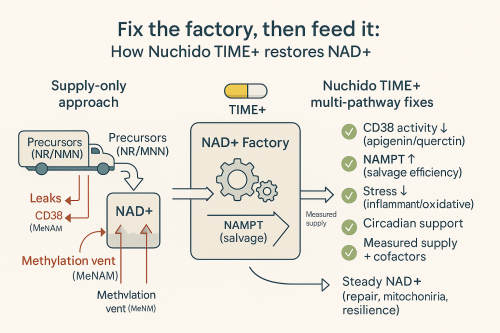
When a factory’s output slows, you do not solve it by dumping more raw material at the door. You inspect the machinery, remove bottlenecks, repair the recycling system, and close leaks. Otherwise, extra supplies may create a larger pile without increasing production.
The same logic applies to NAD+. Cells must produce it, balance it with NADH, move it where needed, use it in energy and repair reactions, and recycle what remains. If that machinery is impaired, flooding the system with precursor may not correct the bottleneck.
Unused precursor will be redirected, converted into other metabolites, broken down, and ultimately cleared. That processing engages enzymes, transport systems, methyl donors, and clearance pathways, and uses up energy and resources for "no benefit".
At best a warehouse full of unused parts is not productivity. The real goal is NAD+ homeostasis. That is the logic behind TIME+. Rather than treating cellular aging as one missing ingredient, TIME+ was designed to support the broader NAD+ network—addressing bottlenecks, supporting recycling, and supplying material the system can actually use. Fix the factory first; then feed it.
The bottleneck: slower salvage
Much of the body’s NAD+ is produced by recycling nicotinamide through the NAMPT-driven salvage pathway. When that pathway becomes less efficient, adding precursor alone may not fully correct the underlying bottleneck.
The leak: excessive consumption
With aging and stress, enzymes such as CD38 can consume more NAD+. Filling the tank while the drain remains open is less efficient than supporting both supply and retention.
Emergency overuse: repair demand
DNA damage activates PARP enzymes that use NAD+ during repair. Supporting lower oxidative and inflammatory strain can help the system avoid spending so much of its NAD+ budget on constant emergency work.
Right-sized supply and cofactors
TIME+ combines measured inputs with pathway and cofactor support so the body can build and use NAD+ more intelligently instead of relying on a single high-dose ingredient.
Beyond NR. Beyond NMN. Beyond simply putting more precursor into the body. TIME+ is designed to support the entire NAD+ system so cells can do more of what youthful cells naturally do.
Clinical trial outcomes—and what the numbers actually mean
The evidence falls into three different categories: a peer-reviewed primary endpoint, graph-derived estimates from published figures, and additional internal Nuchido data. Keeping those categories separate makes the results easier to understand accurately.
Important distinction: the peer-reviewed crossover trial reported significance for several markers but did not publish official percentage changes for SIRT1, NAMPT, or the cytokines listed below. Those percentages are graph-derived estimates from the paper’s figures and should be treated as directional.
| Marker | Timepoint | Approx. % Change | Visual | Significance | Notes |
|---|---|---|---|---|---|
| SIRT1 | Day 14 | +35–40% | Significant vs baseline | PBMC western blot (normalized); increased at Day 14. | |
| SIRT1 | Day 28 | +30–35% | Significant vs baseline | PBMC western blot (normalized); increase sustained at Day 28. | |
| NAMPT | Day 28 | +55–65% | Significant vs baseline | PBMC western blot (normalized); largest protein shift observed. | |
| IL-2 | Day 28 | −15–20% | Significant decrease | Fluorescence-intensity assay; reduction in pro-inflammatory signaling. | |
| IL-4 | Day 28 | −15–20% | Trend (p≈0.055) | Not statistically significant; directionally lower. | |
| IL-5 | Day 28 | −20–25% | Trend (p≈0.078) | Not statistically significant; directionally lower. | |
| IL-23 | Day 28 | −25–30% | Trend (p≈0.073) | Not statistically significant; directionally lower. | |
| Whole-blood NAD+ | Week 4 | +26.5% (mean) | Significant vs baseline & placebo | Primary endpoint (enzymatic assay). LC-MS subset showed same trend but NS (lower power). |
Notes: The SIRT1, NAMPT, and cytokine percentages are approximate readings from figures, not official percentages published by the study authors. Individual responses vary.
How the major NAD+ approaches compare
This comparison separates published human-study ranges from Nuchido’s internal data and clearly notes where independent replication is still needed.
| Approach | How It Works | Reported NAD+ Increase | Strengths & Limits |
|---|---|---|---|
| NMN (Nicotinamide Mononucleotide) |
Direct precursor to NAD+. Your body converts NMN into NAD+ through enzymatic steps. | ~40–60% average increase before dropping down because of methylation salvage (in published human studies, varies by dose & duration). |
|
| NR (Nicotinamide Riboside) |
Another NAD+ precursor, converted first into NMN, then into NAD+. | ~30–50% increase (human studies) before dropping down because of NAD scavenging losses. Similar to NMN but requires extra conversion step. |
|
| Nuchido TIME+ | Multi-targeted: provides precursors, enhances recycling enzymes (NAMPT), reduces NAD-consuming drains (like CD38 activity), and adds antioxidants to protect the cycle. | Up to ~242% sustained increase in NAD+ levels (per Nuchido’s internal human study data). |
|
Energy, repair signaling, and resilience in everyday life
With a stronger NAD+ foundation, daily life may feel different: steadier mornings, more durable focus, and more efficient recovery from physical and mental stress. The point is not to create a temporary sensation. It is to improve the cellular capacity from which energy and resilience arise.
NAD+ also helps cells adapt to changing demands. It participates in redox reactions, supports circadian coordination, and supplies enzymes that help cells recognize damage and organize repair. In that sense, it acts not only as fuel-system chemistry but also as part of the body’s cellular decision-making network.
Designed to fit daily life
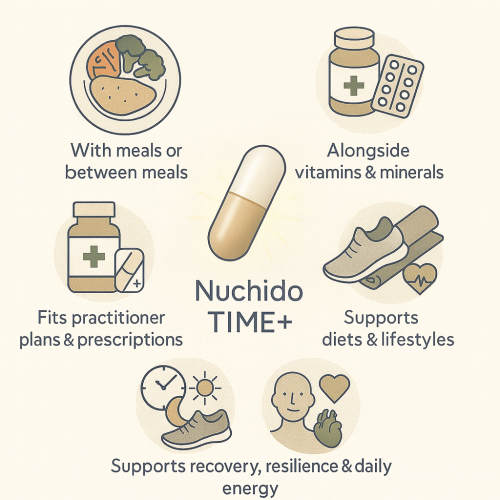
TIME+ is designed as a flexible capsule routine that can be used with or without food and placed alongside ordinary nutrition, exercise, sleep, and practitioner-guided plans.
Because individual circumstances differ, the page also advises people using prescriptions or managing medical conditions to confirm compatibility with their clinician.

Made for trust and consistency
Nuchido emphasizes identity, purity, potency, repeatable batch procedures, and traceable lot records—the practical quality controls that make a supplement easier to use consistently.
The goal is simple: the same formula, the same serving, and the same dependable routine from one bottle to the next.
Nuchido TIME+ — Supplement Facts & How to Use
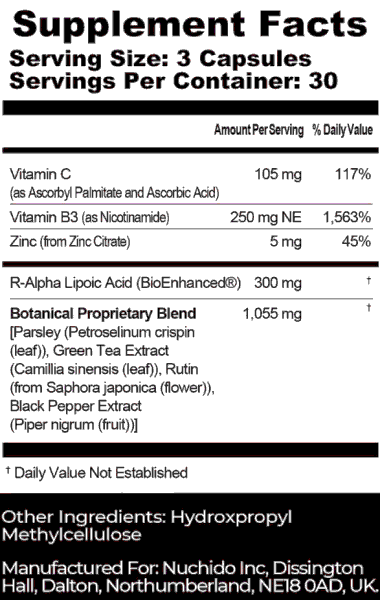
How to Use Nuchido TIME+
Take 3 capsules daily with water, with or without food. You may take all three at once or divide them across the day. Many people prefer morning or early afternoon because the product is being used for cellular-energy support.
- Daily serving: 3 capsules
- Bottle duration: approximately 30 days
- Short-term intensified use: up to 6 capsules daily; additional dosing beyond this is not recommended
- Storage: keep tightly closed in a cool, dry place and out of reach of children
Use guidance: intended for healthy adults; not recommended during pregnancy, breastfeeding, or active cancer. Consult a clinician before use when taking medications or managing a medical condition.
*These statements have not been evaluated by the FDA. This product is not intended to diagnose, treat, cure, or prevent any disease.
Videos and deeper education about Nuchido TIME+
These videos are included for readers who want to explore NAD+, cellular aging, the TIME+ formula, and the broader healthy-aging discussion in greater depth.
Please note: external videos reflect the views of their creators and are shared for education, enlightenment, and entertainment. They are not medical advice or direct product claims.
Nuchido TIME+ Video 1
Nuchido TIME+ Video 2
Nuchido TIME+ Video 3
Nuchido TIME+ Video 4
Nuchido TIME+ Video 5
Nuchido TIME+ Video 6
Nuchido TIME+ Video 7
Nuchido TIME+ Video 8
Nuchido TIME+ Video 9
Nuchido TIME+ Video 10
Nuchido TIME+ Video 11
Nuchido TIME+ Video 12

