


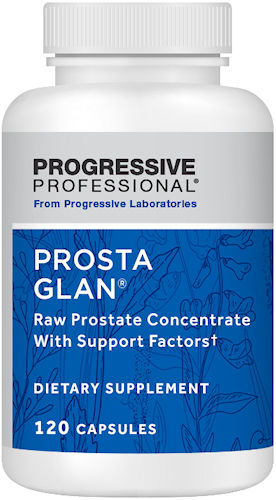
Prosta Glan® — Nutritionally Supports the Prostate With the Most Advanced Ingredients
A large percent of men suffer from an enlarging prostate gland. This can make urination difficult or increase the number of trips to the bathroom that must be taken. While initially benign in nature, an enlarged prostate can affect comfort and quality of life. Our comprehensive men’s health focused formulation helps maintain a healthy prostate gland and promote normal urinary function.
Designed to be the most effective prostate health product on the market, our prostate Health product contains an optimum amount of several botanicals and nutrients that have been shown in numerous studies to be effective at supporting the health of the prostate gland.
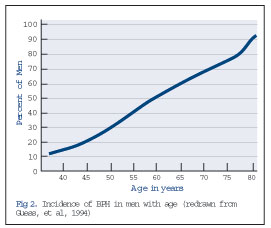
75 Percent of 60 Year Olds Have BPH (Benign Prostate Hyperplasia)
- Fifty to sixty percent of men between 40-60 years of age suffer from BPH.
- This escalates to 75 percent of men by age 60 (Fig. 2).1 The projected annual cost of hospital care and surgical treatment for BPH in the United States is over $1 billion.
- In fact, this condition is so common that physicians routinely ask their over-50 male patients, not “whether”, but, “How many times do you have to get up at night to go to the bathroom?”
- Prostate problems are scary... and eventually reach the point that one cannot urinate at all.
The need for helping men with Prostate Health is real. That's why Prosta Glan® was created and below we list the ingredients in it and how they help:
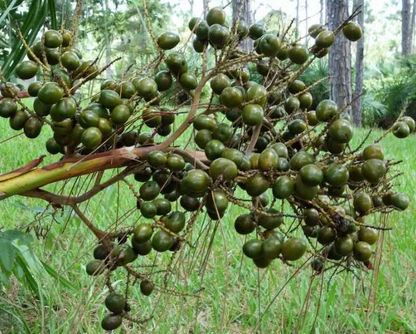
Saw Palmetto has been used historically both for food and for treatment of urinary and reproductive complaints, and for removing mucous. It is the most often used botanical extract in regarding to prostate health because it combats DHT, which is considered the biggest causitive factor in Prostate problems.
- Beginning at about the age of 40, the prostate undergoes a hormone--mediated growth spurt, due to an increase in the testosterone metabolite, dihydrotestosterone (DHT). The enzyme responsible for the production of DHT is found primarily in the cells of the prostate, scrotal skin, testicles and scalp. DHT causes prostatic enlargement as well as male pattern baldness. Saw Palmetto blocks the formation of DHT, inhibits the binding of DHT to prostate cells and blocks the update of DHT into the cell nucleus.
Extracts of saw palmetto berry are being used extensively throughout the world for the relief of BPH. Both the French and German governments approve lipophilic extracts of saw palmetto berries for this purpose.
- Saw palmetto reduces prostate hypertrophy by blocking the conversion of testosterone to dihydrotestosterone (DHT) by inhibiting 5-alpha reductase
- and by preventing the binding of DHT to androgen receptor cell sites.
- These actions increase the breakdown and excretion of DHT.
- Saw palmetto also interferes with the actions of inflammatory substances that contribute to prostate inflammation and reduces the Pro-hypertrophic effects of estrogen and progesterone on the prostate.
Positive results with saw palmetto have been confirmed in numerous open as well as double-blind, placebo-controlled clinical trials.
- All of these studies demonstrated statistically significant improvements in the symptoms of BPH, which included increased volume and rate of urine flow, alleviation of pain and night time urination, and reduced number of voidings per day.
- Overall, these studies showed a consistent benefit of saw palmetto extract, with virtually no side effects of any consequence.
- A striking characteristic of these studies is that most subjects experienced relief within days of beginning the therapy, with benefits continuing to improve over time in many cases, as much as one year of continuing improvement!
- Most studies however, were terminated after 30, 60 or 90 days. A striking characteristic of these studies is that most subjects experienced relief within days of beginning the therapy, with benefits continuing to improve over time, in many cases, as much as one year of continuing improvement!
- Most recently, University of Chicago researchers studied the effects of saw palmetto extract versus placebo on 85 men, 45 years of age or older. The researchers evaluated the subjects based upon three measurements: the International Prostate Symptom Score, a sexual function questionnaire, and the urinary flow rate. At the end of the study, the subjects treated with saw palmetto experienced significant improvement and reduction of symptoms such as frequent urination both during the night and day and interruptions in urination. The researchers stated that their study provides the most conclusive evidence to date that saw palmetto can benefit men with prostate problems.
- Of particular interest was a study that compared Proscar with saw palmetto extract that found that saw palmetto had fewer side effects, provided an equivalent or greater benefit, and was a more affordable form of treatment. The minimum effective dose of saw palmetto in most clinical studies was 320 mg per day.
Phytosterol Extract:
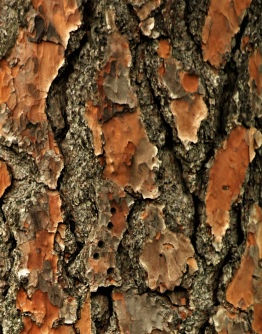
Phytosterol Extract (Beta Sitosterol) is a pine tree trunk extract containing beta sitosterols has been shown to have numerous benefits, which include reduction of hair loss (in combination with saw palmetto), reduction of blood cholesterol, reduction of prostate size and improved skin health. Diets a hundred years ago were rich in plant sterols, but today, most people get very little. So, the inclusion of this ingredient is likely beneficial for virtually all modern individuals.
Research into beta-sitosterol has shown beneficial effects against a wide variety of human ailments, including BPH. Beta-sitosterol is the key ingredient in a prescription formulation in Europe, Azuprostat-beta-sitosterol, which has been demonstrated to improve prostate symptom scores and quality of life, and reduce urine volume and residual urine levels. The research team reported that “beta-sitosterol itself is an effective option in the treatment of BPH.” Beta-sitosterol was also found to reduce the growth of human prostate cancer cells.
Stinging Nettle:
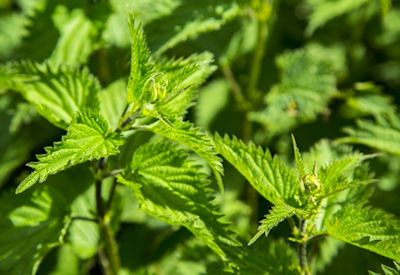
Stinging Nettle is widely used to help alleviate symptoms of reduced urinary flow, incomplete emptying of the bladder, as well as relief of symptoms of arthritis, hay fever and elevated blood sugar. Stinging nettle has also been used since ancient times for nutrition, wound healing and detoxification.
Extracts of stinging nettle are used routinely in Europe to treat BPH. Stinging nettle shares several mechanisms with Pygeum and saw palmetto, but has several actions that are unique. The known mechanisms of stinging nettle on the prostate include its ability to:
- Inhibit aromatase;
- Reduce the binding activity of SHBG
- Inhibit prostate membrane Na+, K+-ATPase activity;
- Block epidermal growth factor receptors;
- Block 5-alpha reductase
Cutting edge therapy now includes glandular extracts. Someone with poor lung function could get the lung tissue from a calf that her body would use to repair her lungs. The same for damaged thyroids, adrenals and other glands including the prostate. The porcine prostate tissue powder in Prosta Glan® provides nutrient tools for one's body to use in "improving" its function and health.
Pumpkin Seed:
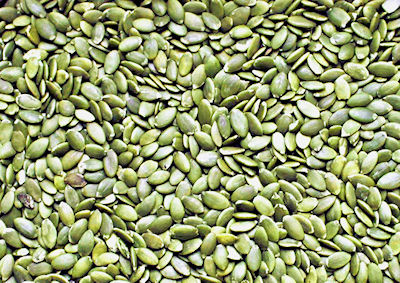
In addition to a large amount of nutrition, pumpkin seed has been shown to reduce inflammatory processes and to interrupt the DHT conversion process that leads to prostate enlargement. Pumpkin seeds are also high in nutrients, especially minerals, omega oils and antioxidants.
Uva Ursi (bearberry):
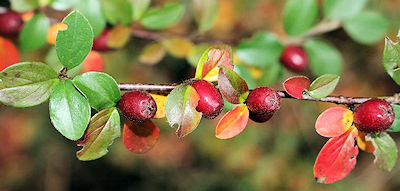
Uva Ursi is widely used for bladder and kidney complaints, Uva Ursi is known to increase urine flow and improve bladder health.
Bee Flower Pollen (graminex):

Bee Flower Pollen is widely used for increased virility and prostate health.
If You're Over The Age of Forty-Five, You Need to Take Action Now to Avoid BPH:
Pay Attention Now... or Else
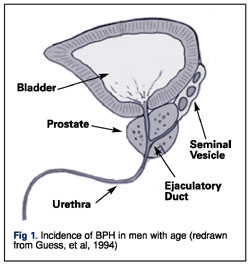
Few men ever consider the walnut-sized fibrous gland called the prostate located just below the bladder, until it starts to give them trouble. After the age of 50, the prostate begins to hypertrophy, or increase in size. This is known as benign prostatic hypertrophy (BPH). The urethra (the tube that carries urine from the bladder) runs through the middle of the prostate. Consequently, when the prostate enlarges the urethra is compressed. (Fig. 1) This causes difficulty in urinating and requires many men to get up three or four times during the night to urinate. Other symptoms of BPH include hesitancy, dribbling, reduced force of the urinary stream, and occasional bleeding or infection. This condition may even proceed to the point of complete urinary obstruction.
Causes of Prostatic Enlargement
Prostate hypertrophy and inflammation are believed to be due to the consequences of a number of age-related changes in the metabolism and levels of male steroid hormones.
After the age of fifty, the level of free testosterone decreases, while levels of prolactin, estradiol, and sex hormone-binding globulin (SHBG) increase. Concentrations of dihydrotestosterone (DHT) the active metabolite of testosterone in the prostate increase, and binding of DHT to prostate tissue increases. DHT stimulates the prostate cells to enlarge, resulting in the swollen gland.
5-alpha reductase is the enzyme that converts testosterone into DHT. Consequently, one approach to preventing BPH has been to use substances that inhibit this enzyme, thereby blocking the formation of DHT, and its prostate-enlarging effect. Estrogen also seems to play a role in BPH by inhibiting the breakdown and removal of testosterone and DHT. The increased ratio of plasma estrogen/testosterone is due to the increased formation of estrogens formed by the conversion of androstenedione to estrone and estradiol by the enzyme, aromatase. Another approach to preventing or treating BPH is, therefore, to use aromatase inhibitors to prevent this estrogenic conversion.
Therapeutic Options for BPH
- Until recently, outside of “watchful waiting”, surgery was about the only solution for this troublesome condition.
- There are prescription drugs which inhibit 5-alpha reductase. These drugs have recently been introduced into the physician’s tool set for treatment of BPH. Use of Proscar, for instance, results in a 20 percent decrease in prostate size in 50 percent of the men who are treated. Unfortunately, Proscar is fairly expensive, and has a significant side effect of sexual dysfunction.
- Fortunately, less invasive and more physiological approaches to prevent and treat BPH are now available, based on our increased understanding of its causes. Clearly, a rational approach should include:
- normalization of prostate nutrient levels
- restoration of steroid hormones to normal levels
- inhibition of excessive conversion of testosterone to DHT (dihydrotestosterone)
- reduction of DHT receptor binding
- reduction of prostatic inflammatory promoters such as prolactin
Prosta Glan® Capsules Ordering Form
Comparative Retail Price: $69.00
Our Price: $60.00
Prosta Glan® Capsules
|
||||||||||||||||||||||||||||||||||||||||||||||||||||||||||||||||||||||||||||||
How to UseFor body weight up to 200 pounds, take 2 capsules twice daily, or as directed by a doctor. For body weight greater than 200 pounds, take 3 capsules, twice daily, or as directed by a doctor. |
Videos and Audios about Ingredients in Prosta Glan® Capsules
We disclaim any claims (if there are any) made in these videos or audios. They are for information, education, enlightenment and entertainment only.

