800.704.0986 comodo secure

  • Improving lives since 2002
  • Fast, Friendly Service
  • Free Nutritional Counseling

The key to health is eliminating toxicities and deficiencies! - Dr. William R. Kellas

shopping cartaccount login

 800.704.0986comodo secure
account loginshopping cart
Scroll To Top

WIN

Weight-Loss Intensified Naturally — a simple, structured system designed to help accelerate fat loss while keeping daily nutrition strong.

Easy to prepare. Easy to follow. Built to help reduce appetite, simplify decisions, and make rapid weight loss more practical in real life.

win shake

Losing Weight With WIN Can Be Remarkably Simple... Just Mix the Powders and Drink!

What WIN Is:

WIN stands for Weight-Loss Intensified Naturally. It is a structured daily program built around foods and supplements—three powders and two encapsulated supplements—taken in place of regular meals. The goal is to make weight loss simpler, more satisfying, and easier to stay consistent with day after day.

Food powders — Mix 3 food powders into water and use the mixture in place of a meal to maintain steady energy without hunger or crashes, every three to seven hours as needed.


Supplements — Swallow 2 types of supplement capsules each day.

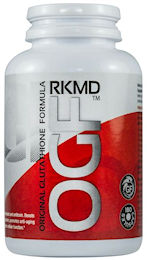
  • 6 OGF capsules
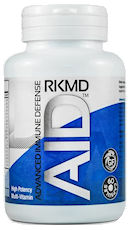
  • and 1 AID capsule

Why WIN Is Helpful for Losing Weight:

The WIN food powders and supplements are designed to help shift the body into a healthier, more sustainable fat-burning state while improving health at the same time. Instead of relying on harsh dieting or chemical shortcuts, the WIN approach focuses on supporting healthier leptin signaling at the hypothalamus and normalizing leptin activity—helping metabolism favor fat burning over hunger, cravings, and energy crashes.

weight loss progression man weight loss progression woman

If you have tried to lose weight before and failed, the problem may not be your effort — it may be your strategy.

  1. Have you tried diets that left you hungry, discouraged, or right back where you started?
  2. Are you tired of weight loss products filled with ingredients you do not really trust?
  3. Would you like a cleaner, smarter approach that helps you lose weight without feeling miserable?
 

Ready for a real reset?

If you answered “yes,” WIN is likely your next step.

For many people, WIN is a fast, powerful path to weight loss & better health—whether your goal is 25, 50, 100, 200+ pounds; whether you’re young or old, male or female.

WIN works by helping reset the Hypothalamus–Leptin metabolic switch—so your body favors fat-burning day & night.

  • In a world of “leaf-level hacks,” WIN targets the roots of weight loss: the hypothalamic leptin switch that governs hunger, satiety, & fat utilization.
  • When that switch is reset to leptin-sensitive, fat burning accelerates, weight normalizes more easily, and health optimization becomes sustainable.
  • Our customers report that the WIN protocol has helped them lose weight quickly and healthily and much simpler and easier than they thought possible. This feedback includes that many men are losing 0.8 to 1 pounds a day and many women are losing between 0.3 - 0.5 pounds a day, while simultaneously improving all health markers.

    Note that many people does not mean typical. Individual results will always vary widely. The WIN program is not appropriate for everyone. You should consult with your health professional before beginning a WIN experience.

  • WIN customers also report that the results received from doing the WIN program boosted their happiness and positive outlook significantly as their overweight condition became a thing of their past... and not of their future.

Unique Examples of WIN Weight loss:

Click on each tab below to see a real world example of WIN effectiveness in very short periods of time:

42 Year Old Former-US-Marine — Before WIN and 54 Days After WIN

Disclaimer: although this a real experience, it cannot be relied upon in predicting the results of anyone else. Your results may be different. No one should undertake to lose weight without the guidance of a physician who knows well the individual.
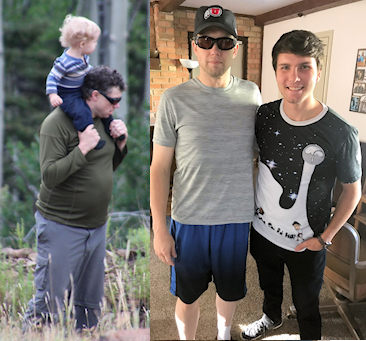
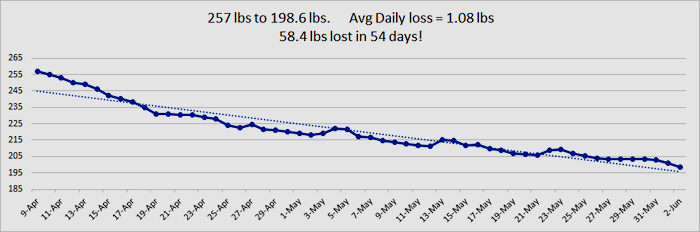
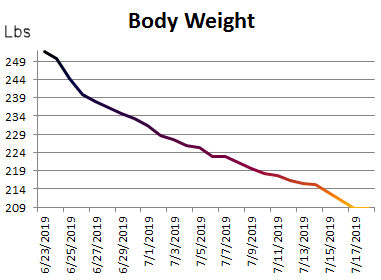
  • In 54 Days, this former-US-Marine and current University graduate student (in his last year of PhD studies in psychology) lost 58.4 pounds... while improving all his markers of health. His average weight loss was 1.08 pounds per day. His energy remained high the entire 54 days, in fact, it improved. During this time his blood pressure went down from 152/91 to 109/72. Also, his HDL/LDL ratios improved while his HDL went up significantly. Also, the TSH/T3 levels normalized. Three days a week, he played volleyball for two hours each time. Other than volleyball, he performed no exercise. His volleyball playing improved significantly because of the increase in energy and stamina he experienced. His day to day weight loss is shown below. Also, listen and watch Kent tell his experience with WIN via video.

33 Year Old, Former-US-Army Special Forces Soldier — Before WIN and 60 Days After WIN

Disclaimer: although this a real experience, it cannot be relied upon in predicting the results of anyone else. Your results may be different. No one should undertake to lose weight without the guidance of a physician who knows well the individual.
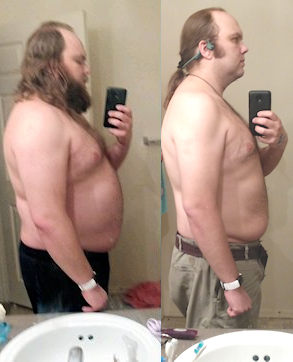
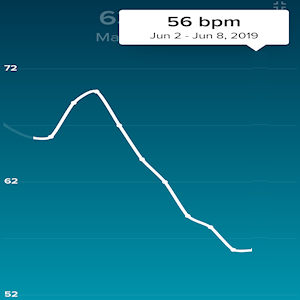
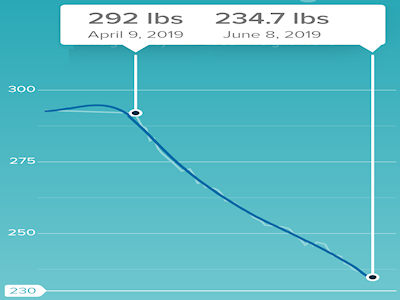
  • In 60 Days, this former-US-Special Forces member and current University student lost 57.3 pounds... His average weight loss was 0.94 pounds per day. During these 60 days, he continued to work full time as an industrial production-line mechanic during a night-shift, and he attended University classes during the day... allowing not too much sleep. His average resting heart rate reduced during this time from 70 to 56 beats per minute.
     
    *Latest update, fourteen days later... he's now lost a total 72 pounds.

35 Year Old Young Man — Before WIN and 22 Days After WIN

Disclaimer: although this a real experience, it cannot be relied upon in predicting the results of anyone else. Your results may be different. No one should undertake to lose weight without the guidance of a physician who knows well the individual.
  • In 22 Days, this young man lost 44 pounds... His average weight loss was 2 pounds per day (although if you only count the last 18 days, he averaged 1.6 pounds per day of weight loss). He did cardio exercise (1 to 3 miles of treadmill and 5 to 7 miles of stationery bike) each day of the 22 days. He drank three WIN shakes per day to achieve this amazing result. He now plans to weight lift extensively to build up muscle bulk.
Weight Loss Chart 22 Days Truman
truman before and after

35 Year Old Young Woman — Before WIN and 30 Days After WIN

Disclaimer: although this a real experience, it cannot be relied upon in predicting the results of anyone else. Your results may be different. No one should undertake to lose weight without the guidance of a physician who knows well the individual.
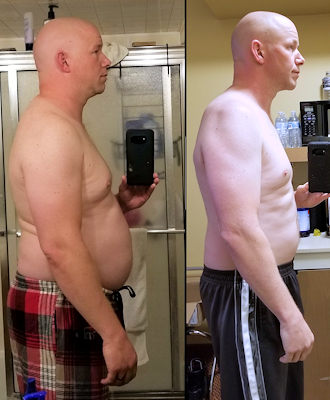
  • In 30 Days, this young woman lost 20 pounds (15 pounds of fat and 5 pounds of skin and supporting blood vessels as shown by a body analyzer). She says that she exercised about five times a week at the gym and is quite pleased because she always had plenty of energy for her demanding job and for exercise. She will be continuing WIN after the Holidays and will send us new pictures in another month or two.
Malisa Before and 30 Days After

65 Year Old Retirement Planner — Before WIN and 90 Days After WIN

Disclaimer: although this a real experience, it cannot be relied upon in predicting the results of anyone else. Your results may be different. No one should undertake to lose weight without the guidance of a physician who knows well the individual.
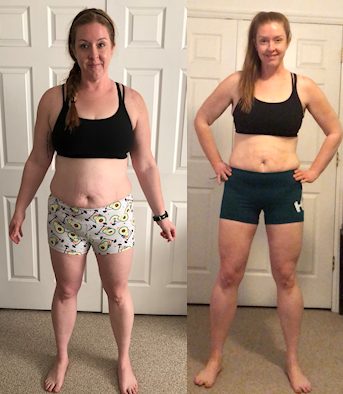
  • In just three months (90 days), our Retirement planner lost 100 pounds... while improving his health and lowering his blood pressure by 20 points. His average weight loss was 1.11 pounds per day. Before WIN he was not able to walk 300 yards without stopping to rest. After doing the WIN program, he went to Europe and walked miles every day and enjoyed feeling young and "fit" again. Later, he took up bicycling and now bicycles 20 to 30 miles each weekend with his wife. WIN transformed his life, forever!

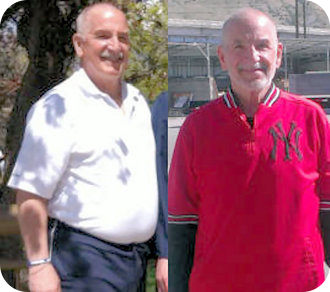
74-Year-Old Who Came Out of Retirement for One Last Race — Pictures Before WIN and At the Race (90 Days After Starting WIN)

Disclaimer: although this a real experience, it cannot be relied upon in predicting the results of anyone else. Your results may be different. No one should undertake to lose weight without the guidance of a physician who knows well the individual.

  • Another example of WIN results can be seen with our 74 year old Boston marathoner who lost 90 pounds in three months. The impetus for him to utilize WIN was that he wanted to run the Boston Marathon for one last time (at age 74), but he had put on quite a bit of weight since his last marathon several years earlier. So, he needed to lose a significant amount of weight in order to be able to have a good chance of completing the race. With help from the WIN powders, he was able to lose 90 pounds so quickly that he calls WIN “magic”. He was featured in Boston Marathon advertisements.

17 Year Old Who Wanted to Be Skinny

Disclaimer: although this a real experience, it cannot be relied upon in predicting the results of anyone else. Your results may be different. No one should undertake to lose weight without the guidance of a physician who knows well the individual.
  • We can’t show our teenager's photos (she’s too shy), but at 17 years of age and 180 pounds of weight, she wanted to be skinny. So, she started taking WIN and in three months got down to 115 pounds. She loved being skinny and was able to change her life completely with skinny clothes and a “skinny” attitude. She has so much more energy than before WIN, during the many years when she carried so much fat. Now she feels light and in charge.


How and Why Does WIN Work For Many People?  

Click on each tab below to learn more about why WIN works so well.
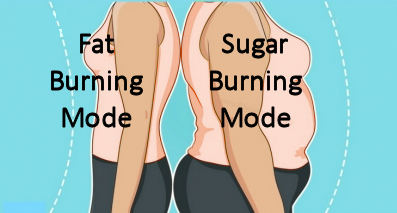
fat burning versus fat storing
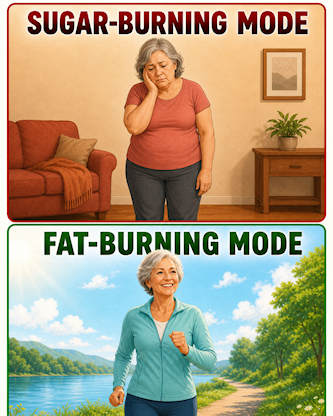
  • In order to stay trim and healthy over the long haul of life, one needs to maintain one's metabolism in the fat burning mode.
    • Fat burning mode simply means that the brain commands body cells to burn fat.
    • Sugar burning mode means that the brain commands body cells to burn sugar.
  • Being in the fat burning mode requires keeping one's Hypothalamus gland (metabolic control center in the brain) sensitive to the Leptin hormone (the amount of Leptin hormone in the body indicates how much fat is stored in the body). Unfortunately, Hypothalamic receptors for Leptin can become Leptin insensitive easily.
  • Once one's Hypothalamic receptors for Leptin are desensitized to Leptin then those receptors will erroneously report to the Hypothalamus gland in the brain that Leptin levels are very low (which, if true, would mean that one was starving). This incorrect communication creates a survival-focused response in the Hypothalamus gland (metabolic control center) wherein it signals the body to lower its energy expenditure, increase fat storage, and only burn sugar for fuel. This is exactly what is needed if one is really starving, but it is the exact opposite of what is supportive of good health and staying trim when there is no famine since fat stores would increase steadily.
  • The benefit of the WIN program is that it helps the Hypothalamus to regain the ability to sense Leptin so the Hypothalamus will signal for the cells of the body to function in the fat burning mode.

Having a sensitive to Leptin Hypothalamus enables:

Far easier weight management
Lower free radical production
Lower blood sugar
Greater health and longevity
 
Leptin Sensing is the Way the Brain Knows How Much Fat is Stored in the Body

To under­stand how the Hypothalamus manages the metabolic mode, one needs to first understand that there is a communication mechanism from fat cells to the Hypothalamus gland letting the Hypothalamus know if sufficient fat reserves exist in one's body (enough fat to outlast a famine or illness). This is a survival mechanism that is inherent to human life.
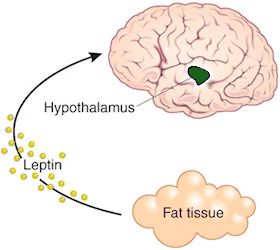
  • The Hypothalamus gland is the metabolic control center in the brain. leptin to hypothalamus
    • It contains receptors for a hormone (chemical messenger) called Leptin.
    • Leptin is made exclusively in fat cells and then circulates in the bloodstream.
    • The Hypothalamus Leptin receptors detect Leptin in the blood.
    • If the Leptin receptors are able to sense sufficient Leptin (which reflects body fat percentage) then the Hypothalamus knows that there is enough body fat for the person to survive a short term famine or illness. In this case, the Hypothalamus is happy, and signals for the high-energy, low-free radical-production fat burning metabolic mode.
    • But, if the Hypothalamus cannot sense very many Leptin molecules then the Hypothalamus will take that to mean that there is inadequate incoming food (meaning a famine or sickness)... and take steps to survive this famine or sickness.
    • The "steps" that the Hypothalamus will take to survive a famine include:
      • Signaling the thyroid, adrenals and cells of the body to lower basal energy expenditure (metabolic set-point) in order to store as many incoming calories as possible as fat.
      • Signaling the cells to burn sugar and store fat in order to build up fat reserves.
The Hypothalamus's Leptin Sensing is a Great Thing Because It Helps Us Survive Famine and Sickness

As long as the Leptin receptors in the Hypothalamus are sensitive to Leptin (rather than desensitized and unable to detect Leptin)  - the Hypothalamus Leptin feedback mechanism works great. It is constantly taking measures to ensure we have enough fat. Consider this example:

  • If one stops eating (for instance, if one is sick, or there is no food to be eaten), fat will continue to be burned for energy, until eventually, when there isn't very much fat left on one's body, Leptin levels will have diminished greatly because with much less fat, very little Leptin will be being made.
  • At some point, when Leptin levels are too low (because there is very little fat in the body making Leptin), the Hypothalamus will recognize the low Leptin situation,
  • and will signal for lowered energy expenditure and switch the body's metabolic mode to fat storing (sugar burning mode). The result of this is that energy expenditure will go down and fat reserves will start to be conserved.
  • Later, when the person starts eating enough food, fat reserves will be built up again because the person is in the fat storing mode and Leptin levels will start to go up.
  • Eventually, the Hypothalamus will recognize that Leptin levels are normal again, meaning the famine pr sickness is over and will switch the body back to the healthier, fat burning metabolic mode.
  • And, that's how the body maintains fat at a high enough level to outlast a famine or illness.

The Hypothalamic Leptin Switch Works Great... Except for When It Doesn't!

  • Leptin receptors can easily be damaged or desensitized to Leptin. When this happens, the metabolic control center in the brain called the Hypothalamus believes that one's fat storage is zero.
  • This causes the Hypothalamus to panic because the Hypothalamus then truly believes the person is starving to death.
  • The Hypothalamus will do everything it can to increase body fat storage. That includes lowering the body's energy set-point, signaling that cells should burn sugar only and try to store every possible incoming calorie as fat.
  • In this panic mode, fat storing will continuously occur and the cells of the body will primarily burn sugar — until the Leptin receptors in the Hypothalamus are repaired and Leptin is perceived as adequate, and the Hypothalamus exits its panic mode.
  • If Hypothalamic Leptin receptors are never repaired and remain desensitized to Leptin, then the Hypothalamus will continuously signal for fat storing until the cells of the body start refusing to make more fat. At that point, blood sugar will rise and Type 2 and 3 diabetes are next on the horizon.
  • So, desensitized Leptin receptors in the Hypothalamus are both a huge cause of health problems and a primary cause of inability to lose weight.

Here's How Leptin receptors get broken!
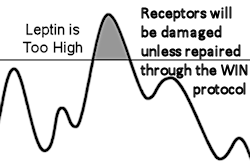
leptin receptors will be damaged
  1. Everyone knows that ear drums can break or smell receptors in the nose can break if sound is too much or smells are too strong. Similarly, if Leptin levels rise above a certain thresh-hold and stay high too long, the receptors for Leptin break or become desensitized to Leptin.
  2. The process of breaking Leptin receptors in the Hypothalamus starts as one accumulates body fat over the years. Eventually when one has accumulated sufficient fat that Leptin rises above the "breaking" point of Leptin receptors. Those receptors then become desensitized to Leptin, and the ability of the Hypothalamus to measure Leptin is gone.
  3. When the Hypothalamus cannot sense Leptin because of broken receptors, the point of no return for most people has arrived, because the Hypothalamus will direct the body (by raising insulin hormone levels) to store more fat when the body already has too much fat.
  4. Health gets worse from that point because individual cells of the body will start to resist the insulin signal (become insulin resistant). Then blood sugar will rise and sugar glycation will seriously damages tissues, cells and organs throughout the body.
  5. Trying to lose weight or get healthier when one's Hypothalamus is Leptin insensitive is like trying to swim upstream — difficult.
Once Leptin Receptors Become Desensitized to Leptin There Are Only Few Ways for Your Body to Come Back to Fat Burning, and Really Only One Viable Way for Most People.
  1. You could get pregnant. Pregnancy establishes fat burning (in order to protect the fetus), regardless of Leptin level.
  2. You could do high-intensity exercise every four hours. Intense exercise that uses up glycogen stores forces fat burning for several hours, regardless of Leptin level. (Most people do not have the physical conditioning to do this. And most people do not have the time.)
  3. You could add muscle mass via twice a week weight training. Even just two short sessions a week of weight training could add five percent more muscle mass over a period of a few years to one's body. That would help virtually anyone's body to increase the calorie burn rate sufficiently so that (coupled with sensible dietary changes) body fat percentages could be reduced enough to get Leptin levels below the receptor breaking point. (This is actually super healthy to do. It just takes a long time.)
  4. You could eat only one meal a day (eat for 1 hour a day, fast for 23 hours a day). This eating style works because it both reduces calories and eventually fixes Leptin receptors in the Hypothalamus (since Leptin levels will go down during fasting hours). It's not as fun, easy, safe, or as healthy as the next option, but it does work for the people who do it.
  5. You could continuously repair Leptin receptors in the Hypothalamus with WIN nutrition while simultaneously keeping blood sugar low. Low blood sugar is a hallmark of the WIN protocol because low blood sugar reduces production rates of Leptin. The WIN protocol also keeps cellular MTOR sensors happy by ensuring there are enough, but not too many, minerals and amino acids in your blood stream. This is important to help avoid hunger.

    Option 5 is do-able for most people with the caveat that one's blood sugar will be much lower than normal during the duration of the WIN experience. (Make sure that your wellness provider understands this and agrees to your plans.)

    • The WIN program helps repair Leptin receptors so that Leptin receptors can sense Leptin.
    • The WIN program keeps blood sugar low so that Leptin production is low.
    • The WIN program furnishes so many nutrients that MTOR cellular receptors will not create food cravings.

That's what makes WIN work so well. It's a WIN-WIN-WIN for people wanting to improve health while normalizing metabolic mode and fat storage.

The WIN program is the best way to lose fat weight because it works with your Leptin control system (your body's natural fat management system) called the Hypothalamic Leptin switch) to re-sensitize Leptin receptors in the Hypothalamus.

We explain this in detail in our free to download Leptin E-Booklet.

Why WIN Can Reestablish the Fat Burning Mode

  1. Low Blood Sugar: WIN powders provide tremendous nutrition, but VERY LITTLE sugar or carbohydrate. As a result, blood sugar will average out lower for the duration of one's WIN experience. Low average blood sugar is what allows fat cells to produce less Leptin, so that the Leptin receptors in the Hypothalamus avoid being damaged by blood sugar spikes.
  2. Gamma Oryzanol: E7 (Essential Seven Superfood)contains Ricotriene which is rich in Gamma Oryzanol compounds which immediately begin to heal Leptin receptors in the Hypothalamus. Once Hypothalamus receptors are healed and again sensitive to Leptin, and Leptin levels begin to stay low so that the Leptin receptors are not re-damaged, the Hypothalamus will signal for the fat burning mode (as it did in one's youth) instead of signaling for sugar burning.
  3. No MTOR driven cribbing: The super-high amounts of nutrients in all five WIN ingredients nourish the body's cells better than they have been nourished before. This allows another type of sensor in each cell called MTOR to not signal for cribbing (a constant urge to hunt for food), which derails other diets that don't provide intense amounts of nutrients.
  4. Can be continued comfortably for weeks or months: If one stays in the fat burning mode long enough, then one can burn off excess fat (and return to an optimum weight, which for for most people is their high school weight).
  5. When one has burned up all the excess fat (IE, reached a point where Leptin is at 4 ng/ml), one can then choose to eat a Leptin friendly diet and discontinue the WIN program.
 
Additional WIN Facts:
  • The Gamma Oryzanol and Tocotrienols is Ricotriene (which is nearly half of E7 by weight) is able to help repair and re-sensitize the Leptin receptors in the Hypothalamus.
    • Once those Leptin receptors are re-sensitized, the Hypothalamus can detect the pounds of fat (and, therefore Leptin) that were in one's body all the time but were previously "invisible" and not being accessed for energy. Upon seeing the availability of that fat, the Hypothalamus can begin signaling for fat burning.
  • WIN's other numerous nutrients ensure that MTOR receptors are satisfied.
    • The MTOR cellular feedback loop focuses on minerals and amino acids. If one has too few amino acids or minerals the result will be that urges to eat will be generated. This is because MTOR receptors won't be sensing enough nutrition in the body. In both animals and people an unsatisfied MTOR feedback loop causes a desire to eat and a feeling of stress.
  • The result of living on the WIN powders and capsules is that the body learns to function again the fat burning mode, both day and night, and starts to "burn away" fat stores.
  • Interestingly, one's fat is exhaled as carbon dioxide... so that one literally breathes fat away. So, any deep breathing one does only helps.
  • The bottom line is that the WIN program helps one move away from metabolic syndrome towards healthy metabolism while burning up excess fat. The result can be totally life-changing.
  • WIN works for young and old!

The WIN Protocol is to Consume WIN Drinks and take a Few Supplement Capsules, Instead of Eating Any Other Foods

Before starting WIN, get approval from your doctor. Here's more information about how to successfully reestablish fat burning in your body.

Avoid a Stress Response by Taking Sufficient Servings

For the first five to ten days

  • Consume three to five servings per day. One needs to consume as many WIN drinks as needed to not feel hungry, tired, or anxious, otherwise, stress responses will prevent fat burning.
  • Fill your stomach with the WIN beverage (you can dilute it until the volume is enough to fill your stomach). It is MUCH BETTER to completely fill (even stretch) the stomach with WIN, rather than to sip the drink slowly over a few hour's time. Filling the stomach releases "stretch" hormones that are very satisfying to the brain.
  • Switching metabolic modes from sugar burning to fat burning occurs during during these first five to ten days. Some people switch more quickly than others due to faster repairing of the broken Leptin receptors in their Hypothalamus glands in the brain, or greater ability to remove sugar from the bloodstream (less insulin resistance), and/or less stress in their daily lives. Hint: not enough sleep creates an internal stress.
  • If you are hungry or unsettled during these first days, it may be that you aren't consuming enough WIN drinks, not sleeping well enough, or not drinking enough WIN beverage to fill your stomach. The more things you do perfectly right, the quicker you will switch to fat burning mode.

After the first five to ten days

  • Most people will consume three WIN drinks daily. However, some people have found they needed only two WIN drinks, and some very active people have found they needed four, or even five WIN drinks to maintain a state of "no hunger" (everyone is different). Space these drinks somewhat evenly apart. The goal is to never be hungry (so that you aren't in a stress mode). Most people consume three drinks per day. Some are completely full with only two WIN drinks per day. If you're still hungry after three drinks, do a fourth one. Always finish your last WIN drink between two to four hours before bedtime.

Example WIN schedules (feel free to adjust to your own personal clock).

  • Example for five servings: 7am, 10am, 1pm, 4pm, and 7pm
  • Example for four servings: 7am, 11am, 2pm, and 7pm
  • Example for three servings: 9am, 2pm, and 7pm
  • Example for two servings: 11:30am and 7pm

More WIN Protocol Details

  • As far as the capsules, one should consume 6 capsules per day of OGF and 1 or 2 capsules per day of AID. It doesn't matter if one consumes them all at once or spaced throughout the day, but for "simplicity", most people take them all at once in the morning.
  • A WIN drink includes three different food powders and water as follows (powder amounts can be adjusted based on body size):
    • 16 to 32 ounces of water. Filling the stomach is more satiating (satisfying) for your subconscious mind. The subconscious mind likes a full stomach and will generate less urges to eat if you stretch your stomach. So, the amount of water in each WIN drink depends on whether you want a stronger taste in your mouth or a fuller stomach.
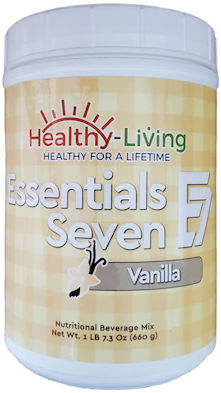
    • 1 Scoop (22 grams) of E7. The Gamma Oryzanol and Tocotrienols in RicoTriene which are a component of E7 are important for repairing damaged Leptin receptors.
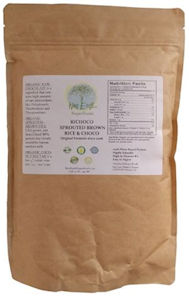
    • 1 to 4 tablespoons of Vegan Protein — larger persons use four tablespoons, smaller persons can use as little one and a half tablespoons per serving. (Hechoco = Hemp with Chocolate, Richoco = Sprouted Rice with Chocolate or Ricocu = Sprouted Rice with Cupuacu) — choose whichever protein/flavor you like best.
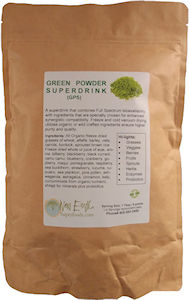
    • 2 to 4 teaspoons (a little less or a little more than one tablespoon, according to your body size) of GPS — this ingredient supplies minerals, antioxidants, nutrients galore.
    • Please note that one can use 3 or 4 tablespoons of Ricotriene and a small amount of Monk Fruit (to taste) instead of E7.

Persons under 130 pounds can use the smaller amounts of powder as shown above. It is always important to have at least as much nutrition as your body needs... extra nutrition won't be a stress, to your body, but too little nutrition will be a stress. So, smaller and/or less active people are candidates for using the smaller serving amounts.

The Whys For Each WIN Component

Click here to see why each component in WIN is important.

Advanced WIN Tactics

For persons in a high stress life.

If you are super-stressed, your cortisol and adrenaline will make it harder to switch to fat burning. Some tactics for overcoming this include:

  • Vitamin D3 - during the winter almost everyone has stress markers because of lack of Vitamin D3, which is the single most important hormone/vitamin on earth. It controls about 10% of all chemical reactions in the body.
  • Earthing - removes cortisol while sleeping.
  • Walking barefoot outside - again removes cortisol.
  • Adrenal resilience - a supplement that significantly helps lower cortisol and other stress hormones.
  • Laughing - is always a best medicine.
  • Sleep - yeah, almost nothing works better than a good night's sleep.

For an Under Functioning Thyroid

When the thyroid doesn't function well, one's energy set-point will be less than optimum for fat loss:

For persons with a severely damaged hypothalamus

When the Hypothalamus Leptin receptors are severely damaged or constantly damaged by high blood sugar, getting cells to switch to fat burning can take longer and/or be more difficult.

For persons with damaged enterchromaffin cells (common with leaky gut) we recommend:

  • Body Biotics - to help repair these damaged intestinal lining cells, which increases positive hormone signaling to all brain cells and tissues.
  • Akkermansia - also helps repair damaged intestinal lining cells, which increases positive hormone signaling to brain cells and tissues.

How Many Bags of Each WIN Food Powder or Supplement Do I need for a Month?

Each bag of WIN powder has a different number of servings, and so lasts a different amount of time. That means they won't run out at the same time. Also, depending on body size, and activity, and nutritional status, one may wish to take relatively more of one powder than the other.

A canister of Seven Essentials (E7) or Ricotriene contains thirty servings. At three servings per day, one canister will last 30 days. At about $60 per canister, 3 canisters a month would cost $180 a month.

A bag of Vegan Protein contains about 60 tablespoons. For an average size and average-activity person, a bag provides 30 servings (at two tablespoons per serving). Someone over 200 pounds would need between 3 and 4 tablespoons pg provides 30 servings (at two tablespoons per serving). Someone over 200 pounds would need between 3 and 4 tablespoons per serving. So, at a cost of $25 per bag (and average of 3.5 bags a month) that's about $88 a month cost.

A bag of GPS has about 200 teaspoons. That's 93 servings at two teaspoons per serving, which is 31 days at three servings per day. At $55 per bag, and 1 bag per month that's $55 per month in cost.

An OGF bottle contains 180 capsules and an AID bottle contains 60 capsules. At a rate of 6 OGF capsules and 2 AID capsules per day each will last a month, for a cost of $70 per month

  • With the above averages in mind, the the total cost will be around $385 per month for most people for three servings of WIN per day. Of course, that cost is offset by the amount of food one doesn't eat each month. This amount could be less for smaller persons and a little more for very large persons.

After Losing Weight With WIN… Then What?

Most people think the victory is getting the fat off.

It is a victory. But it is not the end of the story. In many ways, it is the beginning of the better part.

WIN can help you do something most people struggle to accomplish: lose fat rapidly while providing enough protein to help protect muscle tissue during the process. That is a major advantage.

But there is an important distinction that deserves much more attention:

Preserving muscle is not the same as building it.

And once the excess fat is gone, building some lean muscle becomes one of the smartest next steps a person can take.

WIN Helps Remove the Burden. Muscle Helps Build the Future.

Losing excess fat can make you lighter, more mobile, and more comfortable in your own skin. That alone is wonderful. But if you stop there, you may miss one of the greatest opportunities that weight loss creates.

Once the body is carrying less fat, it is often in a much better position to become stronger, more resilient, more energetic, and easier to maintain.

That is where muscle comes in.

Muscle is not vanity tissue.

It is living, active, calorie-burning, life-supporting tissue that helps determine how strong, capable, and metabolically healthy you will be in the years ahead.

Why Adding Muscle Makes Life Better Later

People often think of muscle only in terms of looks or athleticism. But muscle does far more than fill out a shirt sleeve.

1. Muscle Helps You Burn More Calories

Muscle tissue is more metabolically active than fat tissue. That means a body with more lean muscle generally uses more energy, even at rest. This does not mean you can eat recklessly and never gain fat again, but it does mean your body becomes a little less fragile and a little more forgiving.

In plain language: muscle helps make weight maintenance easier.

2. Muscle Improves Strength for Everyday Life

Strength is not just for the gym. It affects real life: getting out of chairs easily, climbing stairs with confidence, carrying groceries, lifting boxes, traveling more comfortably, playing with grandchildren, staying steady on your feet, and continuing to do useful work without feeling physically overmatched.

A stronger body usually means a more independent life.

3. Muscle Supports Better Blood Sugar Control

Muscle acts like a reservoir for glucose. The healthier and more active your muscles are, the better your body often becomes at handling carbohydrates and maintaining steadier blood sugar. That matters not only for body composition, but also for energy, cravings, and long-term metabolic health.

4. Muscle Helps Protect Against Frailty With Age

One of the most common and underappreciated features of aging is gradual weakness. People often assume they are “just getting older,” when in reality they are losing muscle, losing stability, and losing physical reserve.

Building muscle now creates a buffer for later. It gives your future self more strength to work with. It is a bit like putting money in a savings account that pays out in mobility, balance, and resilience.

5. Muscle Improves Posture, Movement, and Confidence

When the body is stronger, it usually moves better. Posture often improves. Walking can feel easier. Standing can feel more natural. Even the emotional experience of living in your body changes. There is often more confidence, more willingness to be active, and less fear of physical effort.

6. Muscle Gives You a Better “Engine”

Think of fat loss as taking excess cargo out of a vehicle. That helps. But building muscle is more like improving the engine. It changes what the body can do. It changes how efficiently it works. And it changes how well it handles the demands of life.

So What Should You Do After WIN?

Do not go back to careless habits. Do not assume that because the weight came off, the mission is over. Instead, keep the structure that worked and begin shifting your goal from weight loss to body improvement.

Your next mission is simple:

Keep the fat off. Build some lean muscle. Become stronger, steadier, and easier to maintain.

1. Keep Protein High

Continue eating meaningful protein at your meals. For many people, 30 to 40 grams per meal remains an excellent target. Protein gives the body the raw materials needed to repair and build tissue instead of merely holding on to what is left.

2. Add Resistance Training

This is the missing signal. WIN can help reduce fat, but it does not by itself provide the mechanical demand that tells the body to build muscle. Resistance training does that.

You do not have to become a bodybuilder. Even simple, consistent work can help:

  • Bodyweight squats or leg presses
  • Push-ups or chest presses
  • Rows or pulldowns
  • Overhead pressing
  • Core work

Two to four sessions per week can begin changing your body composition, strength, and metabolism in a meaningful way.

3. Keep Walking

Walking remains one of the smartest habits you can keep. During fat loss it helps create the deficit. During maintenance it helps preserve the win. It supports circulation, appetite control, insulin sensitivity, and daily movement without beating up the body.

4. Keep Carbohydrates Controlled

You do not need to fear carbohydrates, but you also do not want to return to letting them dominate your eating. Continue eating protein first, include satisfying fats, and then enjoy a more modest amount of carbohydrate. That sequence often supports steadier energy and better appetite control.

5. Think Beyond the Scale

The scale tells you only one thing: total body weight. It does not tell you whether your body is becoming more useful, more capable, or easier to live in. The better question becomes: Am I building a body that will serve me well in five years? Ten years? Twenty years?

The Real Win After WIN

WIN gets the fat off.

Muscle keeps it off.

Stay structured. Eat protein. Lift a little. Keep moving.

Lose the fat.
Build the engine.


WIN Ordering


On average, WIN products are consumed at the following rate:

  1. E7 - canister lasts 10 days (3 per month needed)
  2. Vegan Protein (Hechoco, Richoco, or Ricocu) - bag lasts 10 days (3 per month needed)
  3. Green Powder Superdrink (GPS) - bag lasts 30 days
  4. Original Glutathione Formula (OGF) - bottle lasts 30 days
  5. Advanced Immune Defense (AID) - bottle lasts 30 days
 

Optionally, the following items may improve one's WIN experience:

  1. Thyroid Resilience - Capsules (purpose is to normalize thyroid hormones and metabolism setpoint so that maximum fat burning is achieved)
  2. Methlyate - Capsules (purpose is to improve mood and sense of well-being by increasing Sam-E)
  3. Saffron - Capsules (supports mood, sleep quality, brain health, and helps remove stress. Important for fat burning).
  4. Acetyl L Carnitine - Capsules (increases conversion of fat to energy very significantly, enabling easier fat burning)


What is in a One or Two Month WIN Kit?


Order a WIN Kit

Select One or Two Month Kit: 
E7 Flavor: 
Vegan Protein Choice: 

Add Individual WIN Products to Your Shopping Cart

Add E7 or Ricotriene To Your Shopping Cart

Most people need 3 E7 Canisters per month.

Type: 
Quantity: 
Add Vegan Protein to Your Shopping Cart

Most people need 3 bags of Vegan Protein per month.

Type: 
Quantity: 
Add Green Powder Superdrink (GPS) to Shopping Cart

Most people need 1 bag of GPS per month.

Type: 
Quantity: 
Add Original Glutathione Formula (OGF) to Shopping Cart

Most people need only 1 bottle of GPS per month.

Type: 
Quantity: 
Add Advanced Immune Defense (AID) to Your Shopping Cart

Most people need only one bottle of AID per month.

Type: 
Quantity: 
Add Monk Fruit to Your Shopping Cart
Type: 
Quantity: 


Ricotriene

Nutrition Facts
Serving Size: 3 to 4 Tablespoons (14 to 18 grams)
Calories Per 12 Grams: 54
Ingredients: 100% Soluble, Stabilized Rice Bran

Hechoco Powder

Nutrition Facts
Serving Size: 2 Heaping Tablespoons (16 grams)
Calories Per 15 Grams: 60
Ingredients: Organic Raw Hemp Powder, Organic Raw Chocolate Powder, Organic Raw Coconut Sap

Richoco Powder

Nutrition Facts
Serving Size: 2 Heaping Tablespoons (16 grams)
Calories Per 16 Grams: 60
Ingredients: Organic Raw Brown Rice Protein, Organic Raw Cocoa Powder, Organic Raw Coconut Nectar and Organic Coconut Milk powder

GPS (Green Powder Super-drink) Powder

Nutrition Facts
Serving Size: 1 Tablespoon (8 grams)
Calories Per 8 Grams: 25
Ingredients: Carrots, Beet, Wheat-grass, Alfalfa-grass, Barley-grass, Oat-grass, Rice Protein, Acacia, Aronia, Gojiberry, Black current, Camu Camu, Blueberry7, Cranberry, Bilberry, Maqui, Pomegranate, Lucuma., Coconut Milk, Pine Pollen, Astragalus, Kelp, Ginger, Turmeric, Organic Alga DHA powder, Minerals, Probiotics

WIN - Frequently Asked Questions


What Do We Mean by Fat-Burning or Sugar-Burning Mode?

We are referring to the main fuel your cells are using to produce adenosine triphosphate (ATP), the energy molecule that powers cellular activity.

For sustained energy, the mitochondria inside your cells rely primarily on two main fuels: fat or sugar. Other terms can make this sound more complicated than it really is. Glycogen is simply stored sugar. Ketones are largely made from fat. Protein is not the body’s preferred long-term fuel and is usually broken down only when needed, with parts converted into glucose and fed into energy pathways. Creatine is not a primary fuel at all; it helps rapidly regenerate ATP for short bursts of power that last only a few seconds.

So, in practical terms, when we talk about the body being in fat-burning mode or sugar-burning mode, we are talking about which of those two fuels is supplying most of the energy for ongoing cellular work.

  1. Fat-burning mode means your body is drawing most of its ongoing cellular energy from fat.
  2. Sugar-burning mode means your body is drawing most of its ongoing cellular energy from sugar.

Also, Sugar Burning Mode = Bone Loss Mode

When a person's body is in the sugar burning mode, then at night, when no food is being consumed, the body will break down bones to get sugar energy to keep the heart beating. This is the true cause of osteopenia and osteoporosis. When the body is in the fat burning mode, the body will be able to burn fat to keep the heart beating, instead of bones.

Why Are WIN and the Hypothalamic Leptin Feedback Mechanism Discussed Together?

Because one of the body’s most important weight-regulating systems involves how the brain interprets stored energy. That system is often described as the hypothalamic leptin feedback mechanism.

Leptin is a signaling hormone made primarily by fat tissue. It travels through the bloodstream to the brain, where the hypothalamus uses that signal to help regulate appetite, energy expenditure, metabolic pace, and whether the body tends to release stored fat or defend it.

  • Fat cells produce leptin, which helps inform the brain about the body’s energy reserves.
  • When leptin signaling is working well, the brain is more likely to allow normal appetite control, healthier energy output, and better access to stored fat for fuel.
  • When leptin signaling becomes impaired — often called leptin resistance — the brain behaves as though energy is scarce, even when body fat is abundant.
  • When that happens, the body becomes inclined to increase hunger, conserve energy, lower metabolic output, and resist fat loss.

Here is the real challenge:

  • Many overweight, sedentary, or metabolically stressed people have high leptin levels but poor leptin signaling.
  • In other words, the signal is present, but the brain is not responding to it normally.
  • That can leave a person feeling stuck in a fat-storing, sugar-dependent, low-energy pattern that makes weight loss much harder than it should be.

This is why WIN and leptin regulation are discussed together. The goal is not merely to eat less. The goal is to create conditions that help the body shift out of a defensive fat-storing pattern and back toward a more efficient fat-burning state.

This is why WIN and leptin regulation are discussed together. Lasting weight loss is rarely just about willpower. It is much easier when the body no longer behaves as though it must defend every pound of stored fat. As leptin signaling improves and the body becomes more willing to access stored fat for fuel, weight normalization can become faster, steadier, and far less punishing.

What Do the WIN Powders Taste Like

There are a variety of flavor options. Chocolate is the favorite, but other flavor options are available.

Can I Do the WIN Program if I Have Diabetes?

Often, yes—but it should be individualized and medically supervised. Many people with diabetes can follow a structured weight-loss plan, but changes in meal timing, carbohydrate intake, activity, and body weight can change how blood sugar responds and how much medication is needed.

The main concern is blood sugar going too low—or sometimes too high—if food intake, activity, and medication are no longer matched correctly. This is especially important for people who use insulin or blood-sugar-lowering medicines such as sulfonylureas or meglitinides.

For that reason, we do not recommend starting WIN on your own if you have diabetes. Instead, review the program with the clinician who manages your diabetes first. They can help decide whether WIN is appropriate for you and whether your medications, meal timing, and glucose targets need to be adjusted.

If your clinician approves the program, it is wise to begin with closer glucose monitoring, keep a source of fast-acting glucose nearby, and follow the plan you were given for meals, activity, and medication adjustments.

People with type 1 diabetes, a history of frequent low blood sugar, or diabetes that is difficult to control should be especially cautious and should only proceed with direct medical guidance.

How Long Can a Person Stay on the WIN Program?

The right length of time varies from person to person. It depends on factors such as starting weight, weight-loss goals, medications, energy levels, overall health, stress load, and how well the program is being tolerated.

That said, WIN has been used successfully for much longer than just a few weeks. We have had many reports of people doing very well on WIN for several months, and we have had reports of individuals continuing for as long as seven months with favorable results. In some of the most dramatic cases, people have reported very substantial weight loss along with improvements in energy, mobility, stamina, and other markers of health.

In other words, WIN is not necessarily limited to a short burst. For some people, it may serve as a highly effective active weight-loss phase for an extended period of time — provided the person is continuing to do well, staying hydrated, maintaining reasonable strength and energy, and not developing signs that the program needs to be adjusted.

The longer a person remains on any structured weight-loss program, the more important it becomes to pay attention to how the body is responding. Anyone with diabetes, blood sugar instability, thyroid concerns, kidney issues, low blood pressure, significant fatigue, or other important medical considerations should work with a qualified healthcare professional before and during the program.

For many people, the best approach is to use WIN for the active fat-loss phase and then transition into a strong maintenance plan once the desired weight or health milestone has been reached. The real goal is not just losing weight quickly, but losing it in a way that leaves the person healthier, more capable, and better able to keep the weight off.

Explain More About Why the WIN Program Works So Well?

Because WIN is designed to solve the problem that causes most diets to fail: they ask the body to give up stored fat while simultaneously triggering the very survival responses that make fat loss harder.

When people simply slash calories, the body often responds with more hunger, more cravings, lower energy, greater irritability, and a stronger tendency to defend stored fat. In other words, many weight-loss plans accidentally push the body into a stressed, resistant, fat-storing state. WIN is designed to do the opposite. Its goal is to help shift the body into a more cooperative, more efficient, fat-burning metabolic mode.

In practical terms, WIN is designed to do three powerful things at the same time:

  • Support healthier leptin signaling at the brain level — One of the central ideas behind WIN is to help the body improve the way it handles its stored-energy signals, especially through the hypothalamus. When leptin signaling is working better, appetite regulation tends to improve, energy regulation becomes more favorable, and the body is generally more willing to access stored fat instead of acting as though it must protect every pound. A core food-based component of that support strategy is Ricotriene found in E7.
  • Reduce the hormonal pressure to remain in storage mode — WIN is designed to help keep blood sugar and insulin demand lower and steadier. That matters because when blood sugar and insulin stay elevated, the body is more likely to keep storing fuel and less likely to release it. As that pressure comes down, the body is better positioned to move toward fat burning, steadier energy, and better appetite control. Over time, this can also help move leptin in a healthier direction.
  • Nourish the body deeply so it does not overreact to fat loss — This is one of the biggest reasons WIN can outperform typical dieting. Cells are constantly reading the nutritional environment around them through nutrient-sensing systems, including pathways such as mTOR. When incoming nutrition is inadequate, chaotic, or imbalanced, the body often shifts toward stress, cravings, reduced output, and protective responses. Typical dieting commonly creates exactly that problem. WIN is designed to avoid it by supplying a dense spectrum of nutrients while weight loss is taking place.

WIN works because it changes the message the body receives: not famine, not panic, not deprivation — but nourishment, stability, and a reason to finally let stored fat go.

That is the difference: most diets fight the body. WIN is designed to work with it.

Why Aren’t WIN Weight-Loss Graphs in a Straight Line?

Because real fat loss almost never happens in a perfectly straight, day-by-day pattern. That is normal.

Even when the body is clearly moving in the right direction, the scale can pause, dip, or jump because body weight is influenced by more than fat alone. Water balance, sodium intake, digestion, inflammation, hormone shifts, physical activity, bowel contents, and glycogen changes can all temporarily affect what the scale shows from one day to the next.

In other words, a person can be making real progress even when the graph looks uneven. Fat loss often occurs beneath the surface first, while the scale lags behind or moves in steps rather than in a smooth downward line.

That is why many successful weight-loss graphs look jagged. The important thing is not whether every day is lower than the day before. The important thing is whether the overall trend is moving downward over time.

Day-to-day weight can fluctuate for many normal reasons, but when the overall trend continues downward, it is a strong sign that real progress is being made.

What if I “need” to eat or drink something at a social event because I do not want to appear anti-social by refusing food and drink?

You can be fully social without surrendering your momentum. In most cases, the best strategy is not to “break” the program just to look polite. The better strategy is to blend in intelligently while protecting the fat-burning progress you have worked hard to create.

At most social events, people pay far less attention to what you are consuming than to whether you are warm, relaxed, and engaged. If you are smiling, talking, and holding a drink in your hand, you will usually appear perfectly social.

So, if your goal is to stay as strict as possible and avoid anything that could pull you out of your fat-burning momentum, the safest move is to choose a non-sweet, non-caloric drink and simply participate socially. Good options include plain sparkling water, mineral water, plain water over ice, unsweetened tea, or black coffee, depending on the setting.

  • Before the event, be prepared. Having your WIN servings before you go can help reduce hunger, cravings, and the feeling that you “need” to eat just to get through the occasion.
  • Once there, hold a drink. A glass of sparkling water or mineral water instantly removes much of the social pressure, because people tend to assume you are already participating.
  • Keep the focus on the people, not the food. Ask questions, stay engaged in conversation, and most of the awkwardness disappears.
  • If someone offers food, keep your answer simple. A calm response such as “I’m good, thank you,” or “I already ate, but thank you,” is usually enough.

If you ever feel you absolutely must eat something, then choose the smallest possible amount of the least disruptive option available. In general, that means avoiding sweets, sugary drinks, breads, desserts, and obvious starches. The goal is to minimize the metabolic interruption as much as possible.

The deeper truth is this: protecting your progress is not anti-social. It is self-respect. You do not need to make a scene, give a speech, or act rigid. You simply need to navigate the moment with quiet confidence.

Bottom line: the best social strategy is usually to arrive prepared, hold a non-sweet drink, enjoy the people, and leave with your momentum intact.

What if I need to do extreme physical labor while doing WIN — will I find it difficult to work as hard as needed because of the modest calories in the WIN powders?

Usually, no. Most people on WIN are able to carry on a normal, active lifestyle, and many continue working physically demanding jobs, including construction and other labor-intensive work.

That said, there is a difference between normal daily activity and unusually high-output exertion. If you are facing a very demanding day — for example, prolonged heavy labor, an intense gym session, or a long competitive ride — your energy needs may temporarily exceed what the base WIN servings alone provide, especially if your body has not yet become highly efficient at using stored fat for fuel.

The practical answer is to plan ahead rather than wait until energy drops. On unusually demanding days, many people do better by adding one or two extra servings of the WIN powders ahead of time. Another option is to include Parent Essential Oils, which can provide additional caloric support while fitting more naturally with a fat-burning approach than relying on sugary foods or drinks.

Just as important is fluid and electrolyte replacement. Heavy sweating can drain sodium and other minerals quickly, and that alone can lead to fatigue, weakness, headaches, muscle cramping, or a noticeable drop in performance. This issue is not unique to WIN — it affects anyone doing hard physical work — but it becomes especially important when intake is more structured.

For that reason, on hot days or during heavy exertion, it is wise to replace electrolytes proactively. We recommend doing that without added sugar. Replenish Pro electrolytes are perfect for such an occasion. Also, Kona Deep Sea Minerals, Body Genesis, or even sea salt in water can be helpful options.

Bottom line: WIN does not usually prevent hard work. But when the workload becomes unusually intense, the smart move is to support the body in advance with extra fuel, fluids, and electrolytes so performance stays strong.

How Did WIN Come to Be?

WIN was born out of a very practical problem: many people wanted the benefits of a low-sugar, nutrient-dense weight-loss approach, but the methods they were trying were simply too hard to live with.

Juicing was one of the biggest examples. In theory, it sounded ideal. In real life, it often became a daily burden — shopping for produce, hauling it home, washing it, cutting it, juicing it, cleaning the machine, cleaning the kitchen, and then doing it all over again the next day. Many people started with good intentions, but the effort was too great to sustain. And because many vegetable juices were hard to enjoy, fruit often had to be added just to make them drinkable — which also meant adding more sugar and slowing the very progress people were hoping to accelerate.

So WIN was designed to deliver what people wished juicing could deliver — but in a form that is far easier to do consistently.

  • Make it simple enough to keep doing. WIN was created to remove the exhausting daily grind of shopping, juicing, mess, and cleanup that causes so many weight-loss efforts to collapse.
  • Keep nutrition dense while keeping sugar low. WIN uses concentrated vegetables and low-sugar fruits selected to help nourish the body without driving the blood sugar swings that can intensify cravings and make fat loss harder.
  • Support a more favorable metabolic direction. The program was designed to help the body move away from a sugar-dependent, fat-storing pattern and toward a more efficient fat-burning mode.
  • Avoid the “deprived and miserable” feeling of typical dieting. Most diets fail because they leave people hungry, tired, and preoccupied with food. WIN was designed to be more supportive, more structured, and easier to tolerate while meaningful weight loss is taking place.
  • Ground the program in real metabolic logic. WIN was built around the idea that weight loss tends to go better when blood sugar is kept lower and steadier, incoming nutrition is more balanced, and the body is not pushed into the kind of stress response that often sabotages ordinary dieting.

In short, WIN did not come from a marketing brainstorm. It came from a real-world need: people wanted something that could help them lose weight quickly, nourish the body well, and still be practical enough to do in everyday life.

That is why WIN exists: to make serious weight loss more effective, more doable, and far easier to live with than traditional dieting or the daily grind of juicing.

After Reaching Your Target Weight, How Do You Avoid Rebounding?

The biggest mistake people make is stopping too soon. They reach their goal weight, feel excited, and then quickly go back to the same eating patterns that helped create the problem in the first place.

If you want to keep the weight off, do not think of WIN as something you stop the moment the scale reaches a certain number. Think of it as something you stay with long enough for your body to settle into its new weight and become less driven to regain fat.

That matters because lasting weight loss is not just about getting lighter. It is also about helping the body’s appetite, blood sugar, and fat-storage signals move in a healthier direction. When those signals are still unstable, rebound is much more likely.

In plain English: once you reach your goal, the job is not quite finished. The smart move is to continue long enough to help the body “accept” the new lower weight instead of fighting to climb back up.

  • Do not rush back to old habits. That is one of the fastest ways to trigger rebound.
  • Be especially careful with large evening meals. Nighttime overeating can make it much easier to drift back toward fat storage.
  • Protect your sleep. Poor sleep commonly increases hunger, weakens self-control, and makes weight regain more likely.
  • Transition intelligently. Move from active weight loss into a deliberate maintenance approach rather than into “anything goes.”

Bottom line: reaching your goal weight is not the finish line. Keeping it off requires staying with the process long enough for your body to settle at the new weight — and then protecting that victory with a smart transition instead of a fast return to old habits.

There is another major key to avoiding rebound: do not just lose weight — build a body that helps keep it off. One of the smartest ways to do that is to gradually build and maintain more muscle. A leaner, stronger body is generally better at using fuel, handling blood sugar, supporting daily energy, and making long-term weight control easier. After the active fat-loss phase, sensible strength training can become one of your best allies in staying trim.

What Most Commonly Slows Results on WIN?

That is a very useful question, because most slowdowns do not happen because WIN “stops working.” They usually happen because certain habits or circumstances begin working against the program.

  • Too many off-plan exceptions. A little here and a little there can add up quickly. Frequent snacks, sugary drinks, desserts, breads, or “just this once” meals can make it much harder to stay in a strong fat-burning rhythm.
  • Poor sleep. When sleep drops, hunger usually rises, cravings tend to intensify, and self-control often gets weaker. Even a good program becomes harder to follow when the body is tired.
  • Stress-driven eating or inconsistent decisions. Stress does not help most people make better food choices. It often leads to grazing, reward eating, or abandoning structure right when structure is needed most.
  • Not enough fluids or electrolytes. Dehydration, especially during weight loss or heavy sweating, can leave a person feeling weak, headachy, drained, or “off,” which can make it harder to stay consistent.
  • Stopping too soon. Some people make good progress, then return too quickly to the very habits that caused the problem in the first place. That is one of the main reasons rebound happens.

The good news is that these problems are usually manageable. When people stay consistent, protect sleep, stay hydrated, and avoid unnecessary exceptions, WIN tends to work much more smoothly.

Bottom line: the biggest threat to results is usually not the program. It is the slow return of the very patterns that made weight loss necessary in the first place.

Please Explain Leptin and the Fat-Burning Mode More Clearly

Leptin is a hormone made by fat cells that helps signal the brain about the body’s stored energy. When that signaling works well, appetite and energy regulation tend to be more favorable. :contentReference[oaicite:4]{index=4}

In many overweight people, the issue is not too little leptin, but poor leptin signaling. In other words, the signal is there, but the brain is not responding to it normally. That can make the body more likely to defend stored fat and less willing to let it go. :contentReference[oaicite:5]{index=5}

That is why long-term success is not just about losing weight. It is also about giving the body time and the right conditions—better blood sugar control, better sleep, less overeating, and better metabolic function—to become more comfortable at a lower weight. When that happens, staying in a healthier, leaner state becomes much easier. :contentReference[oaicite:6]{index=6}

How Do You Know When You’re in a Better Place to Maintain Your Results?

For most people, the answer is not a single lab number. It is a pattern. As the body becomes leaner and more metabolically stable, maintaining progress usually becomes easier.

Some people choose to check body composition from time to time, and that can be helpful. But in everyday life, the more practical signs are whether your waist has come down, your weight has become more stable, your cravings are more manageable, and your body is no longer so quick to regain fat.

  • Your waist is smaller and stays smaller.
  • Your body composition is leaner than before without becoming excessively lean.
  • Your hunger and cravings are more controlled than they were before.
  • Your energy is steadier and you are less driven by urgent eating.
  • You can transition carefully without quickly regaining weight.

The goal is not to chase a magic number. The goal is to become lean enough, strong enough, and metabolically steady enough that staying trim feels more natural and far less like a daily fight.

Bottom line: when your waist is down, your body is leaner, your appetite is calmer, and your weight is staying stable, you are usually in a much better place to maintain your results.

Advanced Tactics for Maximizing Fat Loss on WIN

WIN was designed to be simple. That simplicity is one of its strengths. Most people do not need complicated add-ons to get excellent results. They simply mix the powders, drink them, take the capsules, and stay consistent.

However, for people who want to stack the deck further in their favor — or for those whose bodies seem unusually resistant to fat loss — the following tactics can make WIN work even better. The goal is not to make the program harder. The goal is to remove the most common brakes on fat loss and make the body more willing to let stored fat go.

  1. Be stricter than you think you need to be. One of the fastest ways to slow results is with repeated “small exceptions.” A bite here, a snack there, a few sips of something sweet, or small "won't hurt" regular meal can interrupt the rhythm that helps WIN work so well. The more consistent you are, the easier it usually becomes for the body to stay in a strong fat-burning groove.
  2. Protect sleep as if results depend on it — because they often do. Good sleep helps appetite stay calmer, cravings stay lower, recovery stay stronger, and willpower stay more available. Poor sleep does the opposite. For many people, one of the smartest “advanced tactics” is simply getting serious about seven-and-a-half to nine hours of sleep. If you need help consider taking two capsules of Apigenin, two capsules of L-Theanine, and six capsules of Glycine, 40 minutes before your bed time... for the best sleep ever.
  3. Preserve muscle and, when appropriate, build more of it. A body with more lean muscle is generally better at using fuel, supporting daily energy, and staying trim after the weight is gone. That is why sensible strength training can be such a powerful ally. It does not have to be extreme. Even two to four sessions per week can help preserve muscle during fat loss and make rebound less likely afterward.
  4. Walk more than you think you need to. Walking is one of the most underappreciated fat-loss tools because it is effective, sustainable, and does not usually create the appetite backlash that harder training can create. A daily brisk walk — and even better, short walks after meals when meals are eaten — can quietly improve results.
  5. Use harder exercise strategically, not constantly. For people who are able, periodic higher-output exercise can increase energy demand and help the body rely more heavily on stored fuel. But more is not always better. Overdoing intense exercise can backfire by increasing fatigue, soreness, hunger, and inconsistency. The sweet spot is enough activity to stimulate progress without making the program harder to sustain.
  6. Stay ahead of hydration and electrolytes. Low fluids and low minerals can make a person feel weak, headachy, flat, crampy, or “off,” which can then be mistaken for the program not working. This matters even more in heat, during exercise, or with heavy sweating. Sugar-free electrolyte options such as Replenish Pro, Kona Deep Sea Minerals or Body Genesis can be extremely helpful.
  7. Do not ignore signs of a sluggish metabolic bottleneck. If a person is staying consistent yet progress is unusually slow — especially if fatigue, cold intolerance, constipation, dry skin, hair thinning, or unusually low drive are also present — it may be wise to look more closely at thyroid and broader metabolic support. Some people choose to support that area nutritionally with Thyroid Resilience.
  8. Be especially disciplined at night. That's when most people crave regular food. If you absolutely must eat something or "die", have popsicles made of the WIN drink ready in the freezer, and chew one up.
  9. Reduce stress in practical ways that make compliance easier. The issue is not perfection. The issue is that stress often leads to poor sleep, impulsive eating, and inconsistent choices. Simple things such as quiet walks, prayer, journaling, breathing exercises, sunlight, laughter, and better evening routines can help keep the program easier to follow.
  10. Plan ahead for unusually demanding days. If you know a day will involve very hard labor, an especially intense workout, or long hours without much rest, prepare in advance rather than waiting until you feel depleted. Some people do better by adding an extra WIN serving or by using additional support such as Parent Essential Oils, or Creatine mixed into the WIN drink, so they can stay strong without reaching for sugary foods or drinks.

Bottom line: the best advanced tactics are not exotic. They are the ones that quietly remove the common brakes on fat loss: inconsistency, poor sleep, low muscle stimulus, dehydration, late-night eating, unmanaged stress, and unrecognized metabolic drag.

When those brakes are removed, WIN often becomes easier, faster, and more effective.

Why Are These Products Included in the WIN Protocol?

  1. E7 (Seven Essentials). E7 contains Ricotriene and is very good at helping to restore sensitivity to Leptin receptors. Ricotriene is high in Gamma Oryzanol, a tissue healer and Tocotrienols (a cousin to Vitamin E) that heal all types of tissues and both Insulin and Leptin receptors. Such healing is key to ensuring the desirable fat burning metabolism that enables fat to be easily burned for energy. E7 and RicoTriene also help heal damaged gastrointestinal tissue and nerve tissue.
  2. Organic Vegan Protein — either Hechoco, Richoco or Ricocu, Any of these protein sources are great in terms of providing high quality, easily digested protein to maintain the body's daily cellular repair and operational processes. Hechoco is a hemp sourced protein (with excellent Omega Fatty Acid profiles), while the proteins in Richoco and Ricocu are sourced from great tasting, sprouted brown rice. These proteins are either flavored with Chocolate or Cupuacu. Hechoco and Richoco are flavored with Chocolate (Cocoa) and Ricocu is flavored with Cupuacu (which has a completely non-Chocolate and quite interesting taste). For most people, nothing beats chocolate.
  3. GPS (Green Powder Super-drink) — this food powder contains a plethora of nutrient rich vegetables, berries, herbs, enzymes and dairy-free probiotics. By including it in the WIN program, one is ensured of a huge variety of minerals and nutrients so that one's health and energy remain high.
  4. Original Glutathione Formula (OGF) — this powerful supplement boosts glutathione levels by up to 400%, quenching liberated toxins and free radicals quickly so that one feels great while burning up pounds of fat each week. The main cause of fatigue in the human body is excess free radicals and toxins. OGF helps ensure that free radicals and toxins are more quickly eliminated from the body.
  5. Advanced Immune Formula (AID) — another powerful supplement designed to keep your body totally healthy while fat is being burned like crazy. It especially helps ensure that liberated-from-fat-toxins don't do exit damage to cell membranes by helping cell membranes to be as healthy as possible.

A Leptin Friendly Diet means:

Copyright 2002 - 2026. All rights reserved.

These statements have not been evaluated by the Food and Drug Administration. No product mentioned herein is intended to diagnose, treat, cure or prevent any disease. If you are pregnant, nursing, taking medication, or have a medical condition, consult your physician before making any lifestyle change, including trying a new product or food.

The information on this website is intended as a sharing of knowledge and information from the research and experience of the Healthy-Living.Org staff and contributors. It is not intended to replace a one-on-one relationship with a qualified health care professional and it is not intended as medical advice. You should not use the information on this site for diagnosis or treatment of any health problem or for modification of any medication regimen. You should consult with a healthcare professional before starting any diet, exercise or supplementation program, before starting or discontinuing any medication, or if you suspect you have a health problem. You should keep in mind that cited references to ongoing nutritional scientific study are most likely not accepted by the FDA as conclusive. These references and mentions of benefits experienced by others are disavowed as product claims and are only included for educational value and as starting points for your own research. No food or supplement can be considered safe for all individuals. What may benefit 999,999 of a million people may harm you. Therefore, no one can take responsibility for your health except you in concert with your trusted health professional.